In this Blood Death Knight guide we’re going to tell you how to improve your performance in the game, including optimal rotations and strategies, pros and cons, all about the best gear, optimizing your stats and increasing your overall power. In Patch 10.2.6, BDK is still one of the best tanks in WoW Dragonflight with huge attack power and an enormous health bar.
 4.9
4.9Blood Death Knight Overview
The BDK is one of 6 tanks in WoW. Its distinctive feature is the largest amount of HP among other tanks and the ability to restore it almost instantly with the help of Death Strike.
BDK often plays at limits: healing Blood DK is a real headache for any healer due to the fact that his heath bar constantly jumps, which is why it seems that he is on the verge of death. However, in the right hands, the Blood Death Knight is practically immortal and requires virtually no help from the Healer.
When comparing Blood Death Knight to Protection Paladin, BDK is a rather selfish tank, as he has few utilities that can significantly help the group. Some useful ones for the group include Anti-Magic Zone and Path of Frost. Just kidding. So yes, don’t expect much help from him, with the exception of Raise Ally, but at the same time you can be sure that he will withstand almost any damage.
Blood Death Knight in Season 3
In Season 3, the Blood Death Knight is set to shine in both raids and Mythic+ dungeons. Despite only minor changes throughout Dragonflight, we can confidently rely on our existing strengths to tackle Season 3 content. Our trusty Death Strike and Anti-Magic Shell abilities will be our mainstays, helping us negate troublesome encounter mechanics.
Now, let’s talk about the Season 3 tier set, Risen Nightmare’s Gravemantle. It builds on lessons learned from Season 1 and Season 2. Instead of relying on a random chance for Vampiric Blood procs, this set lets you apply Ashen Decay using Runic Power. You can trigger it with every tick of Abomination Limb or the execute-only detonation from Soul Reaper. While this set may seem a bit weaker than our Season 2 gear, it offers more consistency. With just the 2-piece set bonus, you can expect a reliable 70% uptime on Ashen Decay across up to 5 targets.
Blood Death Knight Strengths and Weaknesses
| Strengths | Weaknesses |
|---|---|
| Outstanding survivability | Low mobility |
| A diverse selection of cooldown abilities tailored to various scenarios: AMS vs magic, Icebound Fortitude vs physical, Lichborne vs fear | Takes more damage than other tanks. So you can die in one-shot |
| Simple rotation | Depends on cooldowns |
Blood Death Knight Changes in Patch 10.2.6
In this section, we will keep you informed about the most recent class updates.
In Patch 10.2.6, Blood Death Knights are receiving some buffs to their Aberrus, the Shadowed Crucible set bonuses:
- 2-Piece Bonus: The damage dealt by Heart Strike and Blood Boil is increased to 20% from 10%.
- 4-Piece Bonus: The chance to get Vampiric Blood has been increased to 10%, which is twice the previous rate of 5%.
Therefore, Blood Death Knights will deal more damage with Heart Strike and Blood Boil, and will have a higher chance to trigger Vampiric Blood, giving them more survivability in combat.
Furthermore, in version 10.2, there was an additional 20% increase in the potency of Soul Reaper across all three Death Knight specializations, further elevating its effectiveness.
Basics of Blood Death Knight Gameplay
As Blood DK you have a limited resource, Runes, which you must manage wisely. One important aspect is maintaining Bone Shield, a somewhat costly but essential protective buff. The rest of your Runes can be used efficiently on Heart Strike to generate Runic Power. This Runic Power fuels your ability to heal yourself and deal significant single-target damage. If you handle this balance correctly, you’ll benefit from a reduction in the cost of Death Strike and a 10% increase in haste.
In the midst of all this, you’ll also incorporate Death and Decay activations for added haste and damage, and use Blood Boil charges to deal damage and enhance your Death Strike further. While it might seem overwhelming at first, it becomes second nature with practice and the right tracking methods. Developing these habits early on will make your Blood Death Knight experience smoother and more effective.
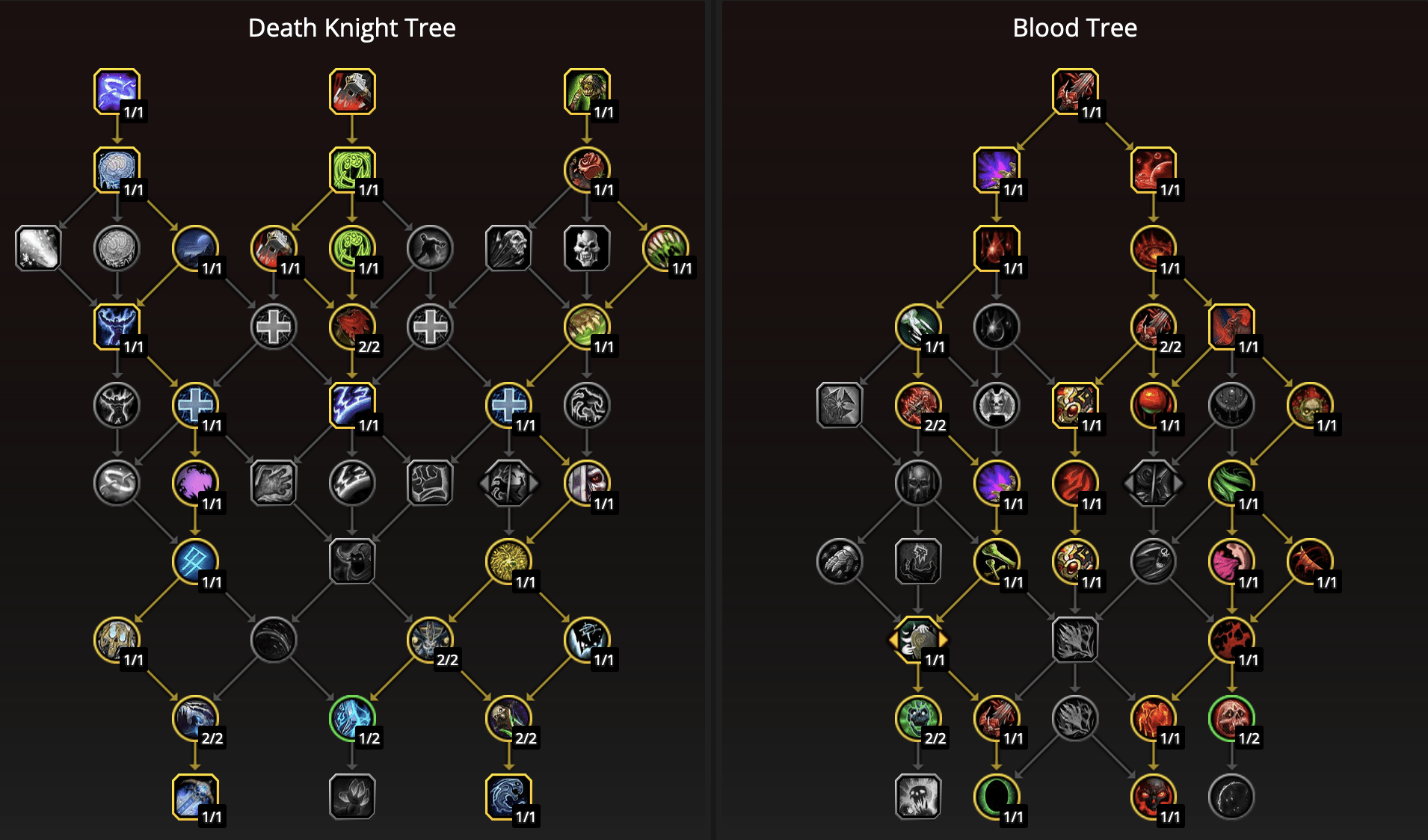
When playing as a Blood Death Knight, here’s a step-by-step guide to help you maximize your effectiveness both outside and during Dancing Rune Weapon:
Outside of Dancing Rune Weapon:
- Keep Bone Shield active at all times using Marrowrend to maintain stacks.
- Cast Death and Decay as long as you’re not currently in your own Death and Decay.
- Maintain at least 5 or more Bone Shield charges, allowing a slight drop in the 10 seconds before Dancing Rune Weapon comes off cooldown.
- Use Tombstone if it meets these conditions: it provides more than 20 seconds of cooldown reduction on Dancing Rune Weapon, consumes 5 Bone Shield charges, and you’re standing in your Death and Decay.
- Spend Runic Power on Death Strike, either when you reach 75 Runic Power or to maintain Icy Talons.
- Keep Blood Boil charges active.
- Use Heart Strike as a filler, making sure to have three recharging Rune slots at all times.
During Dancing Rune Weapon:
- Cast Marrowrend in one of the last three Global Cooldowns (GCDs) of Dancing Rune Weapon to prepare for the next 30 seconds by reaching 10 Bone Shield charges.
- Continue casting Death and Decay, avoiding casting it in the last 5 seconds of Dancing Rune Weapon.
- Cast Soul Reaper.
- Maintain at least 1 or more Bone Shield charge.
- Use Tombstone if it meets the conditions mentioned earlier.
- Spend Runic Power on Death Strike, as mentioned before.
- Keep Blood Boil charges rolling.
- Use Heart Strike as a filler, aiming to have three recharging Rune slots.
- Following these guidelines will help you optimize your performance as a Blood Death Knight, both inside and outside of Dancing Rune Weapon situations.
Cooldowns
BDK has a wide array of cooldowns that need to be monitored and used correctly. I’ll break this cooldown down into Offensive and Defensive, however, keep in mind that even Offensive gives you quite a bit of survivability.
Offensive Cooldowns
| Spell | Cooldown | Advice |
|---|---|---|
| Dancing Rune Weapon | 2 min reduced be Insatiable Blade | Creates an untargetable entity that lasts for 8 seconds. This entity mimics your attacks, although the damage it deals is reduced to only 33% of its original potency. Additionally, any threat it generates is transferred to you. While this entity is active, you also benefit from a 40% increased chance to parry incoming attacks. Use it on cooldown. |
| Empower Rune Weapon | 2 min | Use it when you don’t have enough runes or Runic Power. |
| Abomination Limb | 2 min | Use when you need to gather aggro from a large group of enemies and if you have less than 7 Bone Shield. |
| Tombstone | 1 min | Use it at least if: 1) You will receive cooldown reduction of more than 20 sec on Dancing Rune Weapon by using Tombstone; 2) You have 5 Bone Shield charges available to consume; 3) You are currently positioned within your Death and Decay area off effect. |
Defensive Cooldowns
| Spell | Cooldown | Advices |
|---|---|---|
| Lichborne | 2 min | 15% damage reduction + 15% leech. Use it on cooldown or to remove the effect of fear |
| Icebound Fortitude | 3 min (2 min with talent) | Use Icebound Fortitude whenever it’s off cooldown, as long as it doesn’t overlap with other defensive abilities. However, if there’s a specific moment in a fight where you anticipate needing the stun reduction provided by Icebound Fortitude you should hold onto it until that crucial point. |
| Vampiric Blood | 90 sec reduced by Red Thirst | On cooldown as long as you are taking damage. |
| Anti-Magic Shell | 1 min (40 sec with Anti-Magic Barrier) | You should activate Anti-Magic Shell on cooldown when you are consistently taking magic damage. However, if there’s a valuable ability or effect you can immune with it, it’s advisable to hold onto Anti-Magic Shell for that specific situation to maximize its effectiveness. |
Stats
- Item Level
- Mastery / Critical Strike / Haste / Versatility
Dragonflight ushers in a more balanced stat priority system, where each stat holds its unique value, and having more of one stat enhances the strength of the others. This leads to a more coherent and strategic approach to character optimization.
Blood Death Knights have several secondary stats to consider:
- Critical Strike: Critical Strike is potent offensively and also offers a nearly 1:1 conversion to parry. Its effectiveness depends on factors like the number of enemies attacking you, their ability to be parried, and the damage they deal with parry-able hits. While not a top-tier stat, it’s not one to avoid either, and it gains value in Mythic+ dungeons.
- Haste: Haste contributes to rune generation, with each percent of haste providing a 1.1% increase in rune generation, thanks to Bone Shield. It also improves your reaction time, crucial for optimizing your self-healing with Death Strike.
- Mastery: Mastery, specifically Blood Shield, offers significant value against physical damage and scales in absolute value with the amount of damage you’re taking. The addition of Iron Heart and Gloom Ward has elevated the value of this stat even further compared to its performance in Shadowlands.
- Versatility: Versatility reduces damage taken, boosts self-healing, and provides a minor damage increase. It’s the most universally applicable stat but comes at a higher item budget cost.
Thus, your encore stats will depend on the dungeon you are going to. Let’s say if there is a lot of magic in the dungeon, then you will practically not need a crit.
Leveling a Blood Death Knight
Leveling as a Death Knight shares similarities with other tank classes. The key strategy is to gather as many enemies as possible and then use area-of-effect attacks to defeat them all at once. Death Knights are known for their durability and high damage output. Notably, the ability Blood Boil can affect multiple targets at once.
Additionally, Death Knights can heal themselves quite effectively during combat. The main healing skill, Death Strike, also serves as your primary source of single-target damage. This means you can often handle large groups of enemies for quests or grinding.
Your main challenge isn’t necessarily the strength of the foes you face but rather how enemies might return to their original positions if you lead them too far from where they spawned. This repositioning can be a hindrance during large pulls.
To level efficiently, it’s a smart strategy to blend questing and dungeon runs. Look for quest hubs and regions where multiple quests lead you to the same location. While journeying there, consider doing dungeons. Once you arrive at your quest destination, complete the quests and then dive back into more dungeons. To prepare yourself for Mythic+ dungeons and get solid gear you can use our Mythic Dungeons Bundle.
As a Blood Death Knight, your role as a tank makes your dungeon queue time exceptionally short, especially with the addition of Dragonflight’s new healer specialization. Since many quests involve defeating a certain number of enemies, as a Blood Death Knight, you can often easily round up entire groups of foes and eliminate them with area-of-effect attacks. This approach streamlines your leveling process.
Blood Death Knight Leveling Tips for Dragonflight
Here is a list of tips for playing as a Blood Death Knight:
- Don’t hesitate to round up large groups of enemies when playing as a Blood Death Knight. Your abilities become more potent as the number of targets increases, and remember, you’re a tank, so you can handle it. This approach will significantly speed up your leveling progress. Pulling enemies from a distance is easy with skills like Death Grip, Dark Command, and Death’s Caress. It’s best to start getting used to these abilities during the leveling stage, because in higher difficulty dungeons you will be using these spells often
- Your primary abilities, such as Death and Decay, Blood Boil, Heart Strike, and Death Strike, are your go-to moves throughout the leveling process, just as they are at endgame.
- Take advantage of the fact that tank LFG (Looking for Group) queues are almost instantaneous. Use them to make the most of your time while traveling from one zone to another.
Don’t overlook the importance of consumables to enhance your leveling experience:
- Cosmic Healing Potion: Keep this handy for emergency healing situations when your health is running low.
- Shadowcore Oil: Further increases your damage potential, helping you take down enemies faster.
- Spectral Flask of Power: If you happen to have some Spectral Flasks of Power left over from your adventures in Shadowlands, consider using them sparingly. They can be quite expensive, so it’s wise to use any old stock you have.
- Shaded Sharpening Stones or Shaded Weightstones are usually quite affordable and offer a minor boost to your damage output. They won’t break the bank, so it’s a cost-effective way to improve your combat effectiveness.
- Heavy Desolate Armor Kit: Bolsters your health, giving you a larger health pool to work with.
Additionally, consider using Fried Bonefish or Bear Tartare. These consumables provide a significant movement speed boost after defeating enemies, which can make getting around and completing quests even faster.
How to Gear Up a Blood Death Knight
Given this pluralism of best characteristics, your BiS gear will often change depending on the required characteristics. However, there are some items, especially trinkets and shooting range, without which your character will lose significant strength.
As a general rule of thumb, prioritize the following when choosing gear for your Blood Death Knight:
- Item Level: Focus on increasing your item level, as it typically has a more significant impact on your overall performance than minor variations in secondary stats.
- Secondary Stat Gains: While item level is crucial, secondary stat gains should be considered when choosing between gear options. However, don’t get too caught up in micromanaging secondary stats.
- Strength, Stamina, and Armor: Don’t underestimate the value of Strength, Stamina, and Armor on gear pieces. Even a slight increase in item level is often worth it when considering the additional benefits these primary stats offer.
In summary, prioritize item level above all else, but be mindful of secondary stat gains, and don’t disregard the importance of Strength, Stamina, and Armor on your gear pieces. Balancing these factors will help you optimize your Blood Death Knight’s performance. And we can help you get any type of gear with our WoW Gearing service.

Normal Tier Set
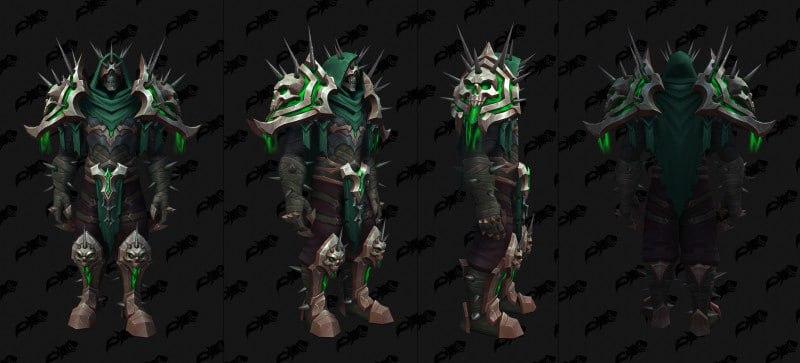
Heroic Tier Set

Mythic Tier Set

LFR Tier Set
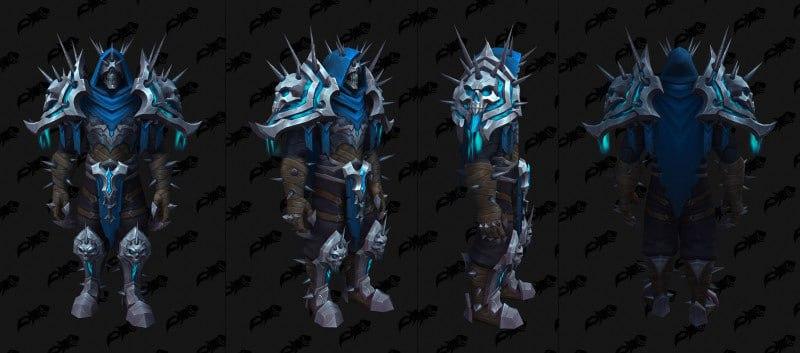
PvP Tier Set

PvP Tier Set
- 2 piece tier set: Consuming Runic Power has a chance to cause your next Heart Strike to apply Ashen Decay, reducing damage dealt to you by 10% and increasing your damage dealt to afflicted targets by 20% for 8 sec.
- 4 piece tier set: Soul Reaper’s execute damage and Abomination Limb’s damage applies Ashen Decay to enemy targets, and Heart Strike and Blood Boil’s direct damage extends Ashen Decay by 1.0 sec.
The most optimal way for Blood DK is to use the set head, shoulders, gloves, and chest. We talked about how to quickly assemble a set in the Dragonflight Tier Sets Guide.
Also don’t forget about Gorehowl, Might of the Warchief – the 2H legendary axe from Fyrakk – a unique axe that no other weapon can match.
Best BDK Trinkets in Dragonflight
Since trinkets are a fundamental element for successful gearing of your BDK it is worth paying a bit more attention to them. Some of them are quite challenging to obtain, but you can always use our help to complete Amirdrassil Raid on Normal Difficulty.
| Trinket | Drop Location | Notes |
|---|---|---|
| Cataclysmic Signet Brand | Smolderon | The new “Stay in Combat” trinket deals minor self-damage upon activation, but its immense strength makes it a valuable choice. |
| Branch of the Tormented Ancient | Gnarlroot | This straightforward trinket operates on a 2-minute and 30-second cooldown, allowing you to place four stacks of a debuff on a target. Each time you use abilities like Death Strike, Heart Strike, Marrowrend, or any other physical effect, one stack is removed, dealing significant Shadowflame damage to all targets within 8 yards. |
| Coiled Serpent Idol | Volcoross | This trinket summons fiery Hydras that continuously unleash flames upon enemies, doing so frequently for a duration of 10 seconds. |
| Rezan’s Gleaming Eye | Atal’Dazar | Thanks to the Bloodshot effect, this trinket receives a substantial 25% damage boost for us, setting it apart and making it more advantageous compared to other specializations. |
Best Crafted Gear for Blood DK in Season 3
Once you acquire the Spark of Dreams, your goal should be to craft the following items at the highest possible item level. Keep in mind that you can always utilize the recrafting system to enhance the item level later if you wish to do so. Once you’ve crafted your best items, you can use sparks to upgrade slots with the lowest item level, working towards boosting your overall average item level. You can read more about Gear Upgrades in our guide.
For Raid:
- Vibrant Wildercloth Shawl with Shadowflame-Tempered Armor Patch
- Primal Molten Vambraces with Shadowflame-Tempered Armor Patch
- Torc of Passed Time and put a flavor pocket in it.
For Mythic+:
- Vibrant Wildercloth Shawl with Shadowflame-Tempered Armor Patch
- Allied Wristguard of Companionship
- Torc of Passed Time and put a flavor pocket in it.
Blood Death Knight in Dragonflight
In Season 3, the Blood Death Knight is set to shine in both raids and Mythic+ dungeons. Despite only minor changes throughout Dragonflight, we can confidently rely on our existing strengths to tackle Season 3 content. Our trusty Death Strike and Anti-Magic Shell abilities will be our mainstays, helping us negate troublesome encounter mechanics.
Now, let’s talk about the Season 3 tier set, Risen Nightmare’s Gravemantle. It builds on lessons learned from Season 1 and Season 2. Instead of relying on a random chance for Vampiric Blood procs, this set lets you apply Ashen Decay using Runic Power. You can trigger it with every tick of Abomination Limb or the execute-only detonation from Soul Reaper. While this set may seem a bit weaker than our Season 2 gear, it offers more consistency. With just the 2-piece set bonus, you can expect a reliable 70% uptime on Ashen Decay across up to 5 targets.
Blood Death Knight End-Game
End-game content in our realm revolves around three primary forms: raiding, Mythic+, and PvP. Each of these avenues offers distinct challenges where class performance varies. To maximize your effectiveness in your chosen content, we recommend diving into our specialized guides for Mythic+ and Amirdrassil, the Dream’s Hope. These comprehensive resources are designed to offer valuable insights and strategies for excelling in PvE gameplay. By following our expert advice, you can enhance your performance and reach your full potential in these demanding challenges.
Best Races for Blood Death Knights
Blood Death Knights can belong to any race from both the Horde and the Alliance.
For Alliance Death Knights, consider Night Elf, Dwarf (either regular or Dark Iron), or Human. These races have some utility that can be advantageous. Night Elves can use Shadowmeld to proactively avoid certain mechanics and gain a 2% passive additive dodge bonus. Dwarves can cleanse all debuffs on themselves every 2 minutes, and Humans can utilize Will to Survive to remove stuns and gain an additional 2% in secondary stats.
Horde Death Knights can choose any race, but Goblins are a preferred choice due to their multiplicative passive haste buff. Additionally, their Rocket Jump ability is handy for repositioning and avoiding mechanics with unavoidable knockbacks.
| Popularity Tier | Race |
|---|---|
| S | Blood Elf |
| S | Human |
| A | Orc |
| B | Draenei |
Improving as a Blood Death Knight
Lastly, we will look at Tips and Tricks for BDK, which will make your life much easier.
Don’t Cap Runes or Runic Power
You can have 3 Runes recharging at once, so holding 4 or more is a waste. Keep 3 Runes on cooldown. Generating Runic Power when at max is a loss. Use Death Strike for damage and defense. Avoid capping Runic Power; it’s rarely better to spend a Rune.
Avoid having too many resources by minimizing time away from your target while moving or dodging damage. Save Blooddrinker for when you’re forced out of melee range.
Plan Defensive Cooldowns
Boss abilities are predictable and can be prepared for. Once you know your raid’s boss strategy, create a plan for which cooldowns to use on specific abilities throughout the fight. Using cooldowns on the spot increases the risk of not having one when needed, leading to potential death.
Planning also prevents using cooldowns reactively, which offers reduced benefits when you’re already low on the health bar. The objective is to activate defensive cooldowns just before the first high-damage attack, maximizing their effectiveness.
Optimal Death Strike Timing
Use Death Strike when you’ve recently taken significant damage to maximize healing and avoid Runic Power capping. React swiftly after damage spikes to heal yourself without overburdening healers.
Maintain Bone Shield
In encounters without melee attacks or extended periods away from the target, Bone Shield may expire. This should be avoided, as regaining stacks costs Runes and Runic Power, leaving you vulnerable for a few seconds.
Use Macros
Macros are in-game tools that enable you to chain spells, customize names and icons, cast abilities based on the target’s hostility, set targeting conditions, and perform various other actions to streamline gameplay.
- #showtooltip
- /castsequence reset=61 Raise Dead, Sacrificial Pact
This macro combines Raise Dead and Sacrificial Pact into one button. The first press summons the ghoul, and the second press, up to 61 seconds later, triggers Sacrificial Pact. This delay allows you to maximize your DPS by sacrificing the ghoul as late as possible within the 60-second window.
- #showtooltip Raise Ally
- /cast [@mouseover,help,dead][]Raise Ally
This macro casts Raise Ally on the player under your cursor, working on both actual corpses and unit frames. If you’re not hovering over an eligible target, it will cast Raise Ally on your current target instead.
- #showtooltip Mind Freeze
- /cast [@focus,harm,nodead][] Mind Freeze
This macro attempts to interrupt your hostile focus target. If you lack a focus target or your focus is a friendly player, it will interrupt your current target instead.
- #showtooltip Death and Decay
- /cast [mod:ctrl, @cursor] Death and Decay; [@player] Death and Decay
This macro allows you to cast Death and Decay directly at your cursor by holding the Control key while casting. Without holding Control, it will cast Death and Decay at your feet.
Re-Control Pet
- /target pet
- /run PetDismiss()
- /use Control Undead
- /petassist
This macro simplifies the process of dismissing and re-casting Control Undead on your controlled undead pet in dungeons like King’s Rest and Atal’Dazar. It eliminates the need to target the pet, making the process more efficient and convenient.
4.9In conclusion, I would like to wish you good luck in mastering Blood Death Knight, which often plays at limits and keeps inexperienced healers on their toes. In this guide, we covered the basics of gameplay, you received important tips, as well as recommendations for the best equipment. All this information and experience will help you in completing any form of content at any level of difficulty, but if you have no time for this, then you can always use our services.
