Path of Exile Atlas progression is the main part of the endgame, where players complete maps, unlock new content, and earn powerful rewards. In this guide, we will explain how the Atlas Skill Tree works, how to progress through maps, how to craft maps, and how to unlock important upgrades like Voidstones and Favoured Map Slots.
PoE Atlas Progression and Skill Tree Guide Key Takeaways:
- The Atlas of Worlds is Path of Exile’s endgame system, where completing maps unlocks Atlas Passive Points and access to increasingly difficult content.
- It lets players customize map content, league mechanics, monster difficulty, and rewards with up to 150 passive points in 3.30.
- Atlas progression revolves around completing maps, sustaining higher map tiers, and investing Atlas Passive Points into mechanics that match your goals.
- You can respec your Atlas points at any time using Orbs of Unmaking.
- Maps are divided into White, Yellow, and Red tiers, with higher tiers offering tougher enemies and better rewards.
- Crafting maps with currency items improves map rewards and can add modifiers that make maps more challenging.
- Completing Map Bonuses, Atlas questlines, and endgame objectives unlocks Atlas Passive Points and advances overall Atlas progression.
- Voidstones empower individual Atlas quadrants and improve map drops, including access to Nightmare Maps.
- Favoured Map Slots increase the chance for selected maps to drop, making it easier to repeatedly farm preferred layouts.
- Maps can be obtained from monster drops, Kirac’s shop, and Orbs of Horizons.
 4.9
PoE Atlas Passive Skill Tree
After beating Kitava in Act 10 of Path of Exile, talk to Commander Kirac to start exploring the Atlas of Worlds. Check the bonus objective of each map by hovering over it in the Atlas and complete it to earn one point for the Atlas passive tree. Here’s how to earn Atlas Passive Points in Path of Exile 3.30:
- Map Bonus Objectives — Complete maps under their required conditions to earn Atlas Passive Points.
- Pinnacle Bosses — Defeat the Maven, Searing Exarch, and Eater of Worlds for the first time to receive 2 Atlas Passive Points and 2 respec points from each.
- Maven Invitations — Complete each of the six special Invitations for the first time to receive 2 Atlas Passive Points and 2 respec points.
- Uber Elder — Defeat the Uber Elder for the first time to earn 4 Atlas Passive Points and 2 respec points.
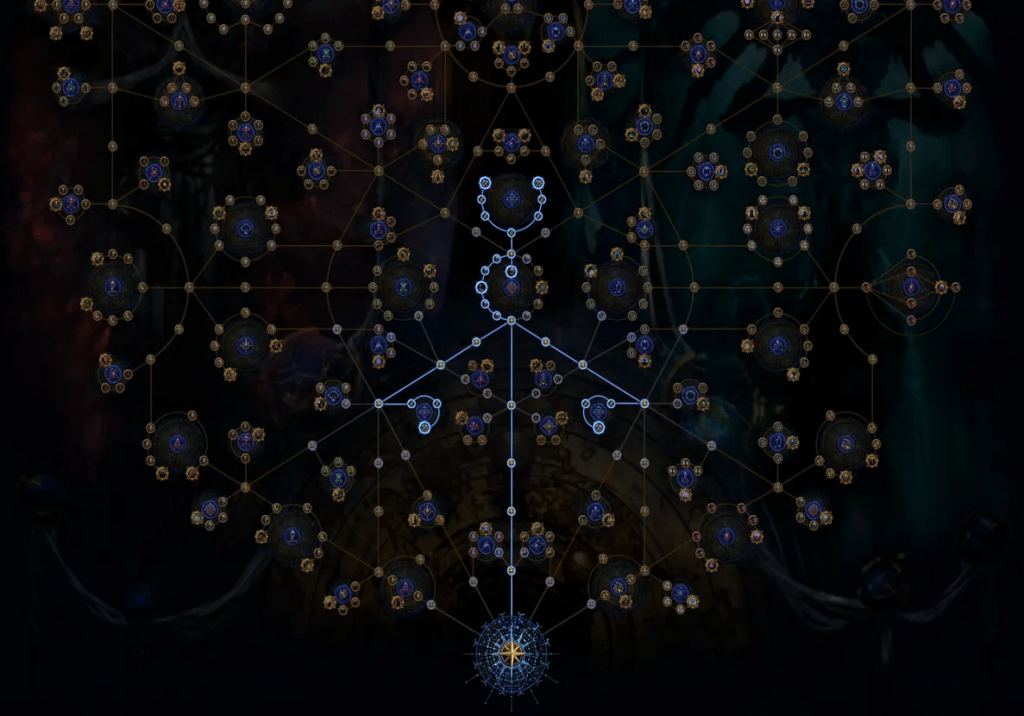
So, to progress in the PoE endgame, you need to run more maps, advance through the new Atlas, and improve their maps through the tree. The Atlas Passive Tree has been redesigned for Covens of Umbra 3.30. You now begin at the centre of the tree and branch outwards, with up to 150 points available through map bonuses and endgame objectives.
The Atlas Passive Tree is a web of bonuses that affect monsters, loot, and league mechanics encountered while mapping. It offers a total of 150 points through completion of specific content.
📌 The 3.30 Atlas Passive Tree has reworked league clusters, new generic bonuses, and Thread-related passives replacing former Scarab clusters.
PoE 3.30 Atlas Passive Tree Changes
The Path of Exile Covens of Umbra update redesigns the Atlas tree around the new endgame systems. Its main changes include:
- The tree now starts in the centre and branches outwards, with up to 150 obtainable Atlas Passive Points.
- Primary league mechanic clusters have been reworked, while Delve and Heist Atlas clusters have been removed.
- Scarab-related clusters have been replaced with Thread-related passives, and some old Scarab effects now appear on the core Atlas tree.
- New generic clusters support Maps, Gold, Divination Cards, and different monster rarities.
- The Phantom Anomalies Keystone has been added, while several older Keystones, including Crop Rotation and Meticulous Appraiser, have been removed.
How to Respec PoE Atlas Passive Tree
Respeccing the Atlas passive tree can be done with ease. Using an Orb of Unmaking grants a respec point that can be utilized at any time. Orbs of Unmaking can be traded and are included in the worldwide drop pool.
Kirac sells them for 2 Orbs of Regret each, making it possible for you to respec your tree multiple times at a reasonable price. It’s possible to change strategies multiple times throughout a league, but it’s best to stick with a plan early on to avoid wasting orbs on unnecessary respecs.
How to Progress PoE Atlas

The Atlas introduced in Atlas of Worlds expansion with all maps completed.

The Atlas introduced in War for the Atlas expansion with all maps completed.

The Atlas introduced in Betrayal expansion with all maps completed.
To start your atlas journey efficiently, we suggest optimizing the acquisition of higher-tier maps. This setup requires few nodes and can be adjusted to fit your strategy later on. The main steps of Path of Exile Atlas progression include:
- Rolling Path of Exile Maps;
- Completing White Maps (Tier 1-5);
- Completing Yellow Maps (Tier 6-10);
- Completing Red Maps (Tier 11-16);
- Exploring Threads of Creation and Shaped Regions.
Each of these steps needs a specific approach that we discribe further in this guide. It’s also beneficial to collect Essence nodes early on as it can make gearing and progression easier during the early days of the league. However, prioritizing map sustain nodes is also important. The tree now starts at its centre, so check the new pathing before following an older setup.
Rolling Path of Exile Maps

Path of Exile Maps open portals to endgame layouts, filled with monsters to defeat for loot. They range from Tier 1 at the bottom of the Atlas to Tier 16 at the top. The maps are colour-coded based on their Tier:
- White Maps are classified as Tier 1-5.
- Yellow Maps are categorized as Tier 6-10.
- Red Maps fall within the Tier 11-16 range.
Crafting maps is a crucial skill for advancing in Path of Exile Atlas. It is possible to craft maps like items by using certain orbs, such as Orb of Transmutation and Orb of Alchemy, as well as Vaal Orbs. Standard Cartographer’s Chisels are no longer obtainable in current leagues. This process results in both positive and negative effects. Positive effects increase the chances of obtaining more items and maps, while negative effects make the map more difficult to complete.
White Maps (Tier 1-5)

Prior preparation is essential before running Path of Exile lower-tier maps, as failure to do so may impede your progress later on. To increase map drops in White maps, it is recommended to use a combination of Orb of Transmutation, Orb of Alteration, and Orb of Augmentation, since a map without modifiers does not yield additional items.
📌 Using an Orb of Alchemy can increase the difficulty and rewards of a map in the game, but it is not advised for beginners.
Yellow Maps (Tier 6-10)

When entering Path of Exile Yellow maps, it is recommended to use an Orb of Alchemy to increase the difficulty and rewards. Without doing this, the Map Completion Bonus will not be received. If the mods seem too challenging, you can use Orb of Scouring to reroll. It is advised to save Vaal Orbs for higher-tier maps. Additional information on this topic can be found under “Atlas Goals” below.
Red Maps (Tier 11-16)

The difficulty of enemies in Path of Exile Red Maps increases significantly, and the higher-tier maps have a lower drop rate, requiring players to craft their maps strategically. Use an Orb of Alchemy and suitable map modifiers to improve rewards while keeping the difficulty manageable.
It is recommended to use Orb of Alchemy and Orb of Scouring as needed to customize the map to your preferences. In Covens of Umbra, you can also add Threads of Creation through the Map Device to select specific league mechanics.
To receive the Map Completion Bonus, it is necessary to corrupt the map by using a Vaal Orb. This action can result in one of four possible outcomes.
- The map can be updated to a new layout, and its level will increase by one tier.
- The map can gain two additional explicit modifiers, up to a maximum of nine.
- The map can become unidentified while retaining its modifiers.
- The map remains unchanged.
Threads of Creation and Shaped Regions
Threads of Creation replace Scarabs in PoE Covens of Umbra as the main way to add primary league mechanics to your maps. They are used in the Map Device and can empower the selected mechanic with additional effects.
- Thread types — There are ten types: Abyss, Bestiary, Betrayal, Blight, Breach, Expedition, Incursion, Legion, Ritual, and Ultimatum.
- Map investment — Spend up to eight Threads to increase the chance of special effects tied to that mechanic.
- Shaped Regions — The Atlas starts with ten Shaped Region types, one per Thread. Maps inside these regions gain free Threads, and completing region objectives improves other affected maps.
- Astrolabes — Use these to place a Shaped Region of a chosen type on an Atlas map.
Primary league mechanics no longer spawn randomly in maps, so check your Thread setup before farming them.
Path of Exile Atlas Goals
Proper prioritization and focus can greatly enhance the endgame experience and long-term enjoyment of the vast Path of Exile Atlas. The major PoE Atlas Goals include:
- Acquiring Completion Bonus;
- Completing Atlas Questlines;
- Unlocking Voidstones;
- Choosing Maps.
Each step benefits to your Path of Exile endgame progression, so learning what to do on each of them is important. Further, we describe the completiong details for each of the said steps.
PoE Map Completion Bonus

Upon defeating the boss of an uncompleted Path of Exile map, you become eligible for the Map Completion Bonus under specific conditions:
- For White Maps (Tier 1—5), complete the map at Magic rarity or higher.
- For Yellow Maps (Tier 6—10), complete the map at Rare rarity or higher.
- For Red Maps (Tier 11—16), complete a Rare Corrupted map.
You will get an Atlas Passive Point as a map completion bonus. It provides permanent bonuses for the Atlas rewards. You can check the map completion bonus by hovering over the map directly on the Atlas and pressing “Alt” while selecting the map. Alternatively, you can do it by examining the map in the map stash tab.
PoE Atlas Questlines
As you progress to Yellow maps in Path of Exile Atlas, you may notice questlines appearing on the right side of their screen. The said questlines eventually unlock three Beacons on the map device. All these questlines are important to Atlas, and each culminates in a bossfight. The three main PoE Atlas Questlines are:
- The Maven;
- The Searing Exarch;
- The Eater of Worlds;
The selected beacon for a map determines the storyline progression, and the quest log on the right of the screen gives instructions on which map tier to complete. Typically, these quest lines begin at Tier 6 maps and continue up to Tier 14-16.
✏️ In Path of Exile 3.30, defeating the Maven, Searing Exarch, or Eater of Worlds for the first time also rewards 2 Atlas Passive Points and 2 Atlas Respec Points each.
Unlocking Voidstones in PoE Atlas

Voidstones are items that can be earned as quest rewards by defeating specific endgame bosses. These stones can be socketed into the four Atlas quadrants, adding effects to maps in those quadrants and increasing the chance for Tier 16 maps to become Nightmare Maps. To unlock Voidstones, you must defeat multiple PoE Bosses, solo or with our professionl players. Here’s a list of Voidstones that you can unlock in Path of Exile:
- Decayed Voidstone — Defeat the Shaper and the Elder (or the Uber Elder)
- Eldritch Voidstone — Defeat the Searing Exarch and the Eater of Worlds
- Originator Voidstone — Defeat the Incarnation of Dread
- Ceremonial Voidstone — Defeat the Maven
Voidstones now affect their respective Atlas quadrants rather than upgrading the entire Atlas to Tier 16. Their effects also improve access to Nightmare Maps.
Choosing Maps in PoE Atlas
Path of Exile no longer uses Favoured Map Slots, as the system was removed in update 3.28. Instead, you can choose which map layouts to run directly through the Atlas, so farming specific areas became much easier. Here’s how the current map selection in Path of Exile Atlas works:
- Generic Maps — Map items now have tiers rather than fixed layouts, such as Tier 10 Map instead of Tier 10 Mesa Map.
- Atlas Selection — Open the Map Device, select an unlocked location on the Atlas, and use a Map item of the appropriate tier.
- Repeated Farming — You can run your preferred map layout repeatedly, provided you have suitable Map items.
- Map Customization — In PoE 3.30, Threads of Creation let you add selected league mechanics to your maps for additional rewards.
This means you no longer need Favoured Slots to target specific map layouts. Focus on unlocking Atlas locations, sustaining Map items, and choosing farming mechanics that suit your build.
Path of Exile Meta Farming Strategies
To progress through Path of Exile’s Atlas quickly, players can use the strategy of meta farming. This involves running maps, completing bonus objectives, and choosing league mechanics through Threads to gain experience points, currency, and items. It’s important to focus on completing specific objectives in the maps, such as Map Bosses or special events, to get powerful rewards. This strategy is effective for quickly progressing through the Atlas and unlocking powerful rewards.
Kirac and Early Map Sustain
Kirac no longer offers Atlas Missions. Instead, you can purchase maps from his shop and reroll its stock using Gold. In 3.30, his shop offers maps up to Tier 14, with higher-tier maps unlocking more slowly and map prices increased. For early progression, prioritize map sustain passives in the redesigned Atlas tree.
How to Get Path of Exile Maps?
To prevent running out of new PoE maps to unlock, it is important to continuously replenish your map collection. Here are some strategies to consider.
- Maps can drop from monsters and map bosses while mapping.
- Kirac sells maps for Gold, and you can reroll his shop inventory using Gold. In 3.30, his shop offers maps up to Tier 14.
- The Orb of Horizons can alter an accessible map into a distinct one.
PoE Atlas Progression and Skill Tree FAQ
In this FAQ section of the guide, we will answer some of the most common questions regarding Atlas in Path of Exile.
How Do You Unlock the Atlas in Path of Exile?
The Atlas of Worlds unlocks after you defeat Kitava in Act 10. Speak with Commander Kirac to begin mapping and start progressing through the Atlas.
How Do You Earn Atlas Passive Points in PoE?
You earn Atlas Passive Points by completing Map Bonus Objectives. Additional points come from the Maven, Eldritch bosses, Maven Invitations, and the Uber Elder, for a total of 150 points in 3.30.
Can You Respec the Atlas in Path of Exile?
Yes, you can refund Atlas Passive Points by using Orbs of Unmaking. You can also find them as drops, trade with other players, or buy them from Kirac for 2 Orbs of Regret each.
What Are Voidstones in Path of Exile Atlas?
Voidstones are endgame rewards that you can get from some Pinnacle Bosses. Each Voidstone empowers an Atlas quadrant and contributes to the chance for Tier 16 maps to become Nightmare Maps.
What Are Favoured Atlas Map Slots in PoE?
Favoured Map Slots let you increase the drop chance of specific maps. You can use these slots for endgame farming to repeatedly run the same layouts.
How To Craft Maps for Atlas Progression in PoE?
You can craft White Maps with Transmutation Orbs, and upgrade Yellow and Red Maps with an Orb of Alchemy. Red Maps also require corruption with a Vaal Orb to earn their Map Completion Bonus.
Which Atlas Passives Should I Take First in PoE?
Early Atlas progression usually focuses on map sustain passives to unlock more maps quickly. After that, you can invest in reworked league mechanic clusters and Thread bonuses that fit your farming strategy.
4.9The Atlas of Worlds is the main part of Path of Exile’s endgame that gives players many ways to improve their maps and rewards. By learning how Atlas Passives, map progression, Voidstones, and endgame bosses work, you can build a setup that matches your goals. Keep upgrading your Atlas, complete new objectives, and choose the farming strategies that work best for your character.
