Path of Exile 2 Currency slightly differs from any traditional in-game gold or credits you might be used to. Instead of having just one universal form of money, PoE 2 uses a series of orbs, shards, and scroll fragments. Each has distinct uses that often serve multiple functions. In our PoE 2 Currency Guide, you will know all the types of PoE 2 currencies, how to use them, and where to get PoE 2 currency in the most efficient way possible. Diving into this guide will help you to get the best gear stats, allow character optimization, and learn everything important for successful endgame progression in Path of Exile 2.
 4.9
4.9Path of Exile 2 Currency Overview
Currency in Path of Exile 2 is more than just coins or trading chips, it’s the backbone of crafting, upgrading gear, and powering up your character. Each type of currency serves a purpose, from simple orbs that reroll item stats to rare currencies that can transform your endgame builds. In this overview, we’ll break down the main types of currency. And to learn about PoE 2 Gold dive into our dedicated guide.
Let’s outline the major Path of Exile 2 Currency types used for various purposes. Generally, all currency can be divided into two basic categories: Orbs and Other Types of PoE 2 currency.
| Orbs | Other Сurrencies | |
|---|---|---|
| Exalted Orb | Orb of Transmutation | Mirror of Kalandra |
| Orb of Augmentation | Orb of Chance | Hinekora’s Lock |
| Orb of Alchemy | Vaal Orb | Reflecting Mist |
| Orb of Annulment | Orb of Unmaking | Gemcutter’s Prism |
| Divine Orb | Orb of Conflict | — |
| Greater Jeweller’s Orb | Regal Orb | — |
| Lesser Jeweller’s Orb | Veiled Orb | — |
| Chaos Orb | Jeweller’s Orb | — |
| Artificer’s Orb | — | |
📌 Disclaimer: This is not the final version of the Guide, we will update it as soon as the new information becomes available. Some of the the earlier reported currencies were not confirmed in the Early Access.
Whether you’re looking to build a powerful character to explore Atlas, craft top-tier gear, or simply trade for valuable items, knowing how to farm currency and use how to use it is essential. Currency drops throughout the game, but efficient farming and using vendor recipes, loot filters, and other methods can help you build up a stash faster. Let’s dive into what makes currency so crucial and explore some effective ways to get currency in PoE 2.
Our team of professional players can deliver the exact amount of any Other Currencies you need.
How to Get More PoE 2 Currency
Path of Exile 2 is set to keep many of the classic currency farming strategies from Path of Exile 1, with familiar League mechanics like Delve, Heist, and Harvest still in play. In this guide, we’ll dive into the best strategies for farming and earning PoE 2 currency, to boost you on your way to building up your wealth.
- Speed Through the Acts and Get to Maps. If you’re starting a new League, rush through the Acts. Getting to maps quickly is the first big step in earning more currency. Here’s why:
- Better item drops: Map items have higher levels, meaning more valuable loot.
- Map mods: Use cartographer’s chisels, transmutation, and alchemy orbs on your maps to boost drop quality. It may seem like a big investment, but it usually pays off.
- Sell valuable maps: Yellow and red maps, especially those with desirable mods, can bring in decent currency.
- Access to League mechanics: Maps unlock content like Blight, Delve, and Harvest in Path of Exile 1, which are goldmines for currency.
- Maximize the Atlas Passive Tree. The Atlas passive tree is a game-changer for boosting currency drops. Customize it to focus on the content you enjoy.
- Use a Loot Filter That Matches Your Progress. A good loot filter is essential in Path of Exile 2, especially when you start running maps. The right filter saves you time and helps you catch valuable drops without clutter.
- Run Heists for Consistent Rewards. Heist contracts are a solid option for farming currency, especially early in any PoE 2 League. They’re reliable, easy to run with basic gear, and a nice choice if you need some quick currency on the side. (Not confirmed)
- Farm Delve for Fossils and Resonators. Delving is one of the steadiest sources of currency, thanks to Fossils and Resonators — always in demand by crafters. The deeper you go, the better the loot. So keep your gear solid and dive as far as you can to find those high-value items. (Not confirmed)
- Sell Leveling Uniques Early in the League. Leveling Uniques are hot items at the start of a League. You can get any Unique items from us, such as Headhunter, which is great for Speedfarm. If you score a Unique with solid early-game stats, put it on the market while everyone’s still looking to power through the early content.
- Bulk Sell for Better Profits. Got a stash full of fossils, essences, or divination cards? Don’t sell them one by one — bulk buyers often pay more just for the convenience of getting a bunch at once. This is a core PoE 2 currency strategy for a reason.
- Use the Crafting Bench Wisely. Skip wasting random currency on rolling mods. Instead, use the crafting bench in your hideout for controlled tweaks, whether you’re fine-tuning items for yourself or boosting pieces you plan to sell.
- Run Low-Level Heists for Easy Cash. Low-level heists are quick and can provide a nice stream of currency, especially early on. They’re easy to clear and add up over time, so don’t ignore them if you need some extra cash. (Not confirmed)
- Sell Influenced Items for a Profit. Influenced items are popular among crafters, especially ones with high-demand mods. You can sell them as-is or throw on some basic crafts to make them more appealing. If you are not confident in your crafting skills, you can use our Gear Crafting service.
- Farm and Sell Essences. Essences are a go-to source of currency, and farming them is simple. Higher-tier essences, like Remnants of Corruption, are especially valuable and sell fast, particularly at the beginning of a League.
- Try Currency Flipping. Keep an eye on currency prices and buy low to sell high. Currency flipping is a reliable way to grow your stash if you’re savvy with the market.
PoE 2 Orbs
In Path of Exile 2, currency farming revolves around orbs, with Divine Orbs and Chaos Orbs ranking as two of the most essential. These orbs fuel the economy, providing powerful crafting options and critical trading leverage. Below we have arranged the confirmed orbs in order of increasing value and rarity. We can provide any amount of Chaos Orbs to help you save time.
Orb of Transmutation
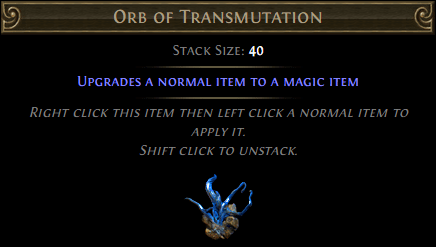
Rarity: Very Common.
Uses: Players primarily use these during the early stages of crafting. They are also very useful early in the campaign to upgrade Normal Item (white) items to more Valuable item (blue), providing small but helpful boosts. Players can also use them to upgrade Flasks to Magic rarity, which enhances the flasks’ effects.
Don’t hesitate to use these when the opportunity arises using them early on can provide much-needed upgrades at a crucial time. So, if you have high-level Flasks and plenty of Orbs of Transmutation, consider spending them to enhance your Flask’s effectiveness!
Orb of Augmentation
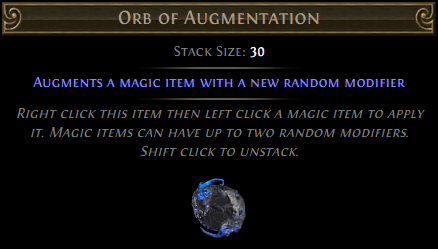
Rarity: Very Common.
Uses: You can use these to add a second modifier to a Magic item after an Orb of Transmutation has already been applied. During the campaign, you can also use them on basic items to apply an advanced upgrade or to add a second modifier to a Flask. In advanced crafting, they are used to add a second rare modifier to an item before moving on to more complex crafting processes.
Note: A Magic item can only have two modifiers: one prefix and one suffix.
Orb of Alchemy
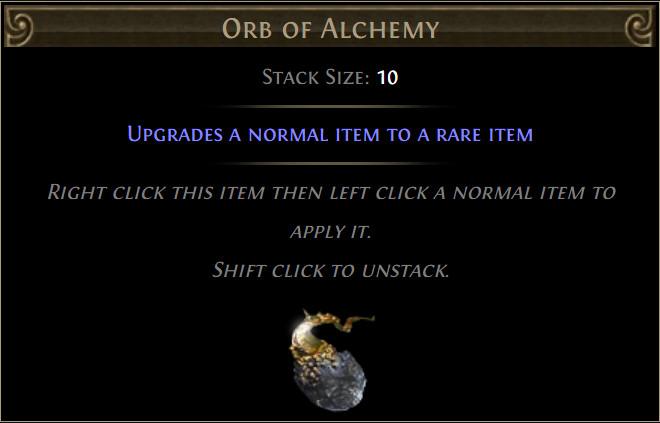
Rarity: Common.
Uses: The primary use of Orbs of Alchemy is to upgrade an item to Rare. This Orb gives it at least four modifiers, potentially creating powerful gear if the modifiers roll favorably. During the campaign, these orbs can be highly valuable when used on strong item bases. Consider using them on weapons to seek damage upgrades, on boots to try for Increased Movement Speed, and on jewelry or body armor to gain bonuses to Life and Resistance.
Orb of Chance

Rarity: Uncommon.
Uses: Orbs of Chance provides the opportunity to upgrade an item to a random rarity item. Like an Orb of Alchemy, this can sometimes result in a significant power boost for your character like movement speed.
On very rare occasions, Orbs of Chance can upgrade an item into a Unique item of the same class. The specific Unique item created depends on the base item used. If you know which Unique item can be created from a particular base item, you have a chance to roll that Unique provided the base item level meets the Unique’s requirements.
Chaos Orb
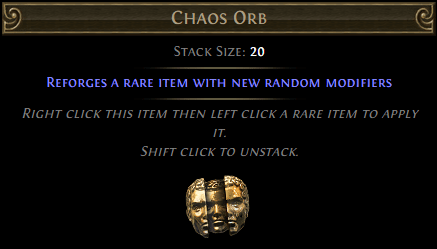
Rarity: Uncommon.
Uses: You can use Chaos Orbs as a gamble to possibly massively improve an item if you have an item. Chaos Orb gives you a chance to remove one of the bad modifiers to replace it with a good one. This should be used very sparingly, and with caution, especially during the campaign. Don‘t gamble on items you‘re using, in case the Chaos Orb removes a good modifier and replaces it with a bad one-just save your Chaos Orbs for average items that have a chance to turn into gigantic upgrades should you get lucky.
Orb of Regret
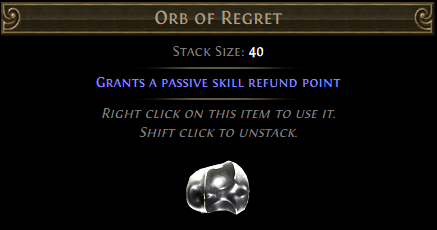
Rarity: Uncommon.
Uses: Orbs of Regret are the respec points in Path of Exile 2. Using one allows you to remove a point from the Passive Tree and reassign it elsewhere, making them especially valuable when you want to make significant changes to your build.
Not available in the Early Access.
Vaal Orb
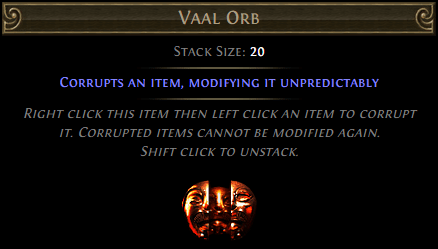
Rarity: Maybe Uncommon.
Uses: You can find Vaal Orbs in Path of Exile 2. This Currency is purely random, you can use it on your items and get corrupted items or super strong items.
Regal Orb
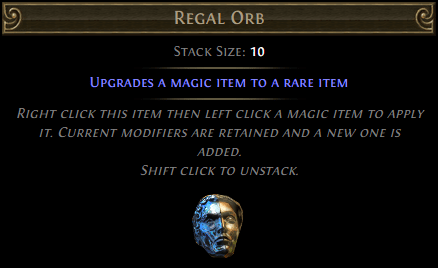
Rarity: Very Uncommon.
Uses: Regal Orbs have limited and specialized applications. Specifically, you can use them to upgrade a Magic item with up to two modifiers to a Rare item with three modifiers or upgrade a Magic item with one modifier to a Rare item with two modifiers. Because of this, you can utilize Regal Orbs in advanced crafting, where players carefully follow a deliberate process to create highly specific items.
Orb of Annulment
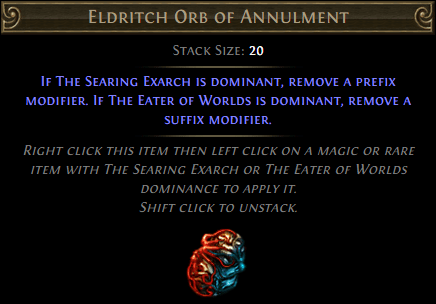
Rarity: Rare.
Uses: Orbs of Annulment are a high-end crafting currency used to remove a random modifier from an item. While this may seem counterintuitive to newer players, if used correctly, Orbs of Annulment can be among the most powerful orbs in the game. For example, removing an unwanted modifier can create an opportunity for further refining an item’s potential.
Note: Keep in mind that Magic items can only have one prefix and one suffix modifier, while Rare items can have a maximum of three prefixes and three suffixes. This creates key opportunities for using Orbs of Annulment to perfect your item as you aim to roll ideal modifiers.
Artificer’s Orb
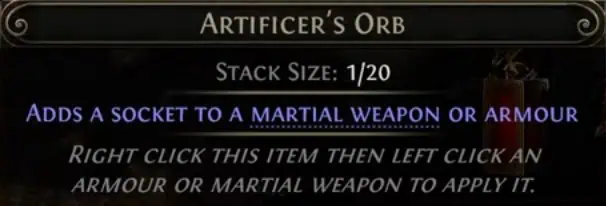
Rarity: Rare
Uses: Artificer’s Orb adds a Rune Socket to your Martial Weapon or Armour. You can add max x2 on Two-Handed weapons and Body Armor, and x1 on other equipment. This will further improve your items by adding a socket or a modifier.
The best way to get Artificer’s Orb is to break items with sockets. As a result, you will receive Artificer’s Orbs. When you collect 10 of these shards, you will be able to get Artificer’s Orb.
Exalted Orb
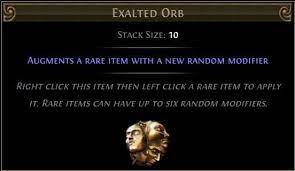
Rarity: Very Rare.
Uses: Exalted Orbs are among the rarest forms of currency in the game, allowing you to add modifiers to a Rare item without removing any existing modifiers, unlike Chaos Orbs. These items hold extreme value, so do not use them carelessly, especially on items you don’t plan to keep long-term. Instead, save them for high-end crafts, where experienced players can fully maximize their potential.
In PoE 2 Early Access Exalted Orbs is the main currency at this stage of economic development, as we use it for trading expensive and high-demanded items.
Divine Orb
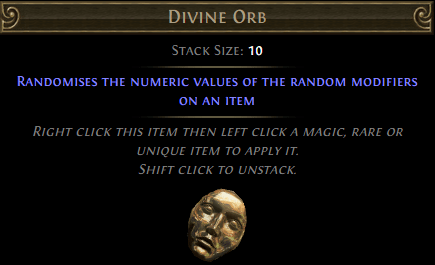
Rarity: Very Rare.
Uses: Divine Orbs are a currency item used to randomize the numerical values of an item’s modifiers. This process may improve the quality of the modifiers. For instance, if a Unique item has a modifier ranging from +1% to +5% to Maximum Resistances, and your item currently has +1%, using a Divine Orb allows you to reroll that value, along with all other modifiers that have value ranges on that item, potentially resulting in higher stats.
Due to the extreme rarity of Divine Orbs, you should be cautious when using them. Only use a Divine Orb if an item has significant potential to benefit from better modifier rolls, otherwise, it is better to save it. We can provide you with any quantity of Divine Orbs to save you time.
Jeweller’s Orb
The Jeweller’s Orb is a unique type of currency you’ll encounter as you explore the world of PoE 2. There are several types of Jewel Orbs in Path of Exile 2, each capable of adding more sockets to your gems as you progress through the game. All socket colors in Path of Exile 2 will be white. No more Blue sockets or Green sockets.
- Low-Quality Orbs of Jeweler: Used on an item to add a socket for a gem, increasing the socket count from 2 to 3.
- Jeweller’s Orb: Further increases the socket count of a gem from 3 to 4. It can also sometimes increase an item’s socket count from 2 to 4.
- Greater Jeweller’s Orb: Increases the number of sockets on a gem from 4 to 5, and, in some instances, from 2 to 5.
PoE 2 Other Currencies
However, orbs are not the only form of currency in Path of Exile 2. Scrolls, fragments, and essences exist to give further flexibility to crafting and trading. Of course, each of those currencies has different uses, like rerolling modifiers, upgrading gear, or unlocking special options when you’re crafting. Knowing how to use and farm these other currencies can add a lot of value to your PoE 2 currency strategy by adding more ways to maximize profit and enhance your items.
Mirror of Kalandra
Rarity: Super Rare.
Uses: Although developers have not confirmed whether the Mirror of Kalandra expensive currency will appear in Path of Exile 2, it remains one of the rarest, most iconic, and most valuable items in the entire game.
The mirrors in Path of Exile 1 have but one purpose: to create an exacting copy of the best-crafted items in-game. Usually, a player invests quite a lot of money in crafting a really good item and then lets somebody else copy that item for a certain amount as a service fee. A Mirror of Kalandra is very expensive. You can use it on only the best things because the copies retain all the modifiers and stats of the original.
Removed PoE 2 Currency
In Path of Exile 2, developers removed or reworked several traditional currency items to match the new mechanics.
- The Orb of Alteration no longer reforges Magic items with new modifiers and has been removed.
- The Orb of Fusing, used for reroll links between sockets, is also gone because PoE 2 now features auto-linked sockets.
- Chromatic Orb, which changed socket colors, has been removed since all sockets are now white. This change eliminates the need for recoloring items.
- The Orb of Scouring, which reset items to Normal rarity, is also missing. Its return is uncertain despite its significance in crafting Path of Exile 1.
4.9In Path of Exile 2 currency is all about versatility. Which one can be used one way or another: enhancement of gear, alteration of items, properties, or even trading. The secret to maximizing the power and efficiency of your character is to know how to use the currency. Gaining a deeper understanding of the intricacies of each type of PoE 2 currency, in addition to smart crafting, farming, and trading strategies, will surely enable consistent progression throughout the game. Your builds will become that much better with PoE 2 currency strategy and you will be better equipped to succeed at challenging endgame content.
