Diablo 4 leveling has changed a lot compared to the old version of the game, so a fresh route matters much more now. In this Diablo 4 Leveling Guide, we will cover how leveling works in the current version of the game, the best path for your first character, the fastest way to level alts, difficulty progression, gear priorities, and the biggest mistakes that slow players down.
Diablo 4 Leveling Guide Key Takeaways:
- Diablo 4 leveling no longer follows the old World Tier and 1–100 structure from older guides.
- The best Diablo 4 leveling route depends on whether you play your first character or an alt.
- Difficulty progression matters a lot, so staying too long on low difficulty slows your leveling down.
- The best Diablo 4 leveling methods now come from choosing the right activities at each stage, not from one fixed dungeon.
- Gear upgrades, Elixirs, and account-wide unlocks still make a huge difference during leveling.
- A good Diablo 4 leveling strategy should also prepare your build for endgame, not just rush raw XP.
 4.9
4.9How Diablo 4 Leveling Works

The Diablo 4 leveling process is not the same as when the game was launched. Leveling up characters and Paragons are no longer related, and the present character level cap is 70. Thus, your leveling strategy revolves around getting to level 70 as efficiently as possible before moving on to Paragon and the endgame.
📌 The old system of 1–100 leveling and World Tier progression is no longer the main system used.
The present Diablo 4 leveling system is well-defined, and it gets you through the regular difficulties and only afterward to the Torment difficulties. If you want to jump straight into the Torment tier world, you can ask our team for Power Leveling, which will save you lots of time.
Diablo 4 Leveling Progression
The simplest method of Diablo 4 leveling at the moment would be to look at it as a route consisting of different stages rather than just an endless amount of XP grinding. The first stage helps create the foundation of your character, while the second evaluates how well you created it by making it face tougher challenges. And finally, the third stage is all about getting ready for Torment and Paragon.
Here is a sample Diablo 4 leveling plan:
- Choose a difficulty level that allows killing and mobility at high speed. At the very start, you need a relatively easy mode that will let you complete your activities cleanly and effectively.
- Work on your basic skills and equipment. The Diablo 4 leveling process becomes effective if your build becomes active very quickly.
- Use the midgame leveling as preparation to enter the endgame. At this moment, the gear optimization and building cleanup become more important as you continue leveling.
- End leveling with transition into Torment and Paragon. When reaching the point where your cap appears, you need to enter the endgame smoothly.
Diablo 4 Difficulty Progression Explained
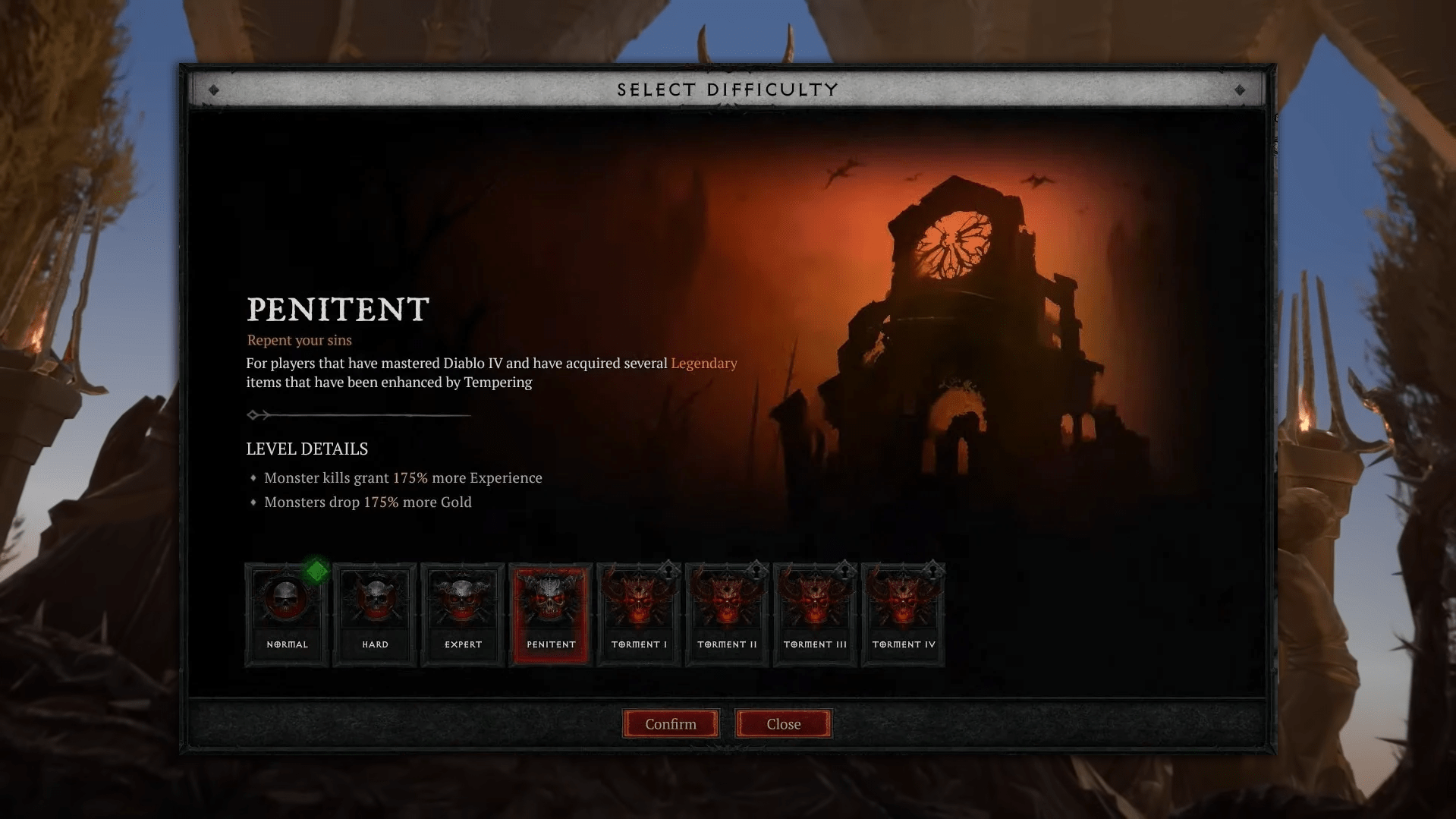
Diablo 4 has implemented a new difficulty scaling system as opposed to the previous World Tier setup. The normal progression involves progressing from Normal to Hard, followed by Expert and Penitent levels of difficulty.
On the other hand, the endgame content sits at the Torment difficulty level that allows for greater difficulty scaling via different tiers. Ultimately, the rate at which you will level up greatly depends on your chosen difficulty.
| Difficulty | How It Unlocks | What Is It Best For |
|---|---|---|
| Normal | Unlocked by default | Best for very first steps, weak early builds, or casual pacing |
| Hard | Unlocked by default | Good if your class clears comfortably from the start, and you want better rewards |
| Expert | Unlocks after completing the Prologue | Best once your build has a real skill setup and basic gear support |
| Penitent | Unlocks at Level 50 | Best for stronger midgame progression before Torment |
| Torment I–XII | Unlocks through Pit progression | Endgame difficulty for Paragon, stronger loot, and serious gear progression |
The fun part is, greater difficulty is only good when your build still feels smooth. If fights start taking too long, the extra rewards stop being worth it. So the best Diablo 4 leveling strategy is not “always play harder,” but “move up when your kill speed still stays strong.”
Diablo 4 Seasonal vs Eternal Leveling
In Diablo IV Seasonal and Eternal leveling, you have access to all the same game mechanics, character classes, and progressions. The only difference is that your experience of progression will be highlighted differently. In Seasonal leveling, everything is designed based on resetting the process, while in Eternal, this mode is aimed at continuous development.
| Realm | What It Is | Features | Best For |
|---|---|---|---|
| Seasonal Realm | Fresh seasonal start with new characters | Season Rank, Season Blessings, seasonal rewards, Battle Pass, and Reliquary progress | Players who want a reset, structured goals, and the current season loop |
| Eternal Realm | Permanent home for long-term characters | Stable long-term progression without seasonal resets | Players who want to keep building the same characters and avoid restarting |
| Shared Between Both | Core Diablo 4 content and permanent system updates | Campaigns, classes, expansion systems, and major permanent gameplay changes | Anyone who wants the main Diablo 4 experience, regardless of realm |
At the moment, Seasonal leveling seems to be the best choice for those players who are looking for an extremely active progression cycle in Diablo IV Season 13. However, if you value the development of your character rather than season’s awards, then Eternal leveling may suit you better. In addition, after the end of each season, all seasonal characters are transferred to Eternal progression.
Diablo 4 First Character Leveling

If you’ve just created your first or a new main character in Diablo 4, it’s better to stick to a straightforward leveling approach. The optimal choice would be to follow the story, get used to your class along the way, and refrain from going off on side quests until you have cleaned up the entire map.
The Diablo 4 main leveling process cannot be considered speedrunning. This stage is focused on unlocking the game properly to make further characters easier to progress through. By the way, our Leveling Bundle helps not only to reach the level cap for your main char, but also level up the Paragon Boards and prepare for the endgame.
Diablo 4 Best First Character Leveling Route
Here is the optimal leveling path for the first character in Diablo 4:
- Start on an easy difficulty level. Normal difficulty is perfect for a blind run. Hard is suitable if you can kill enemy packs easily with your character.
- Prioritize completing the main questline first. Main quests are a perfect fit for your first character and provide a clear leveling path. In addition, they unlock other quests and dungeons in the correct order.
- Explore side activities only when needed. Strongholds, local events, and dungeons in close proximity may be beneficial. Otherwise, long trips will reduce your efficiency in leveling Diablo 4.
- Keep your character’s build straightforward and easy to use. Use a simple damage pattern, efficient area-of-effect abilities, and spells without specific requirements regarding items.
- Update your gear frequently, but avoid spending too many resources. Make sure you feel comfortable while playing, but don’t go too far until your gear lasts longer.
- Complete the storyline before starting alt leveling. After finishing the main storyline, all subsequent runs will be more enjoyable and efficient.
Diablo 4 Alt Character Leveling

Alt leveling in Diablo 4 becomes a breeze after completing the account preparation process. It happens due to the absence of downtime thanks to campaign skipping, sharing map progression, account-wide unlocking of the Altar of Lilith, and faster skill acquisition at the beginning stages.
The main distinction here lies in the fact that an alt does not require playing from scratch. It only requires getting online quickly, completing the early stages successfully, and moving on to harder stages depending on your build’s potential. It will be especially easy for those who have already beaten the Lord of Hatred campaign, since a new character can enter endgame-style leveling right away.
Diablo 4 Best Alt Leveling Route
This is how we recommend approaching alt leveling in Diablo 4:
- Do not complete the campaign if your account is eligible for skipping it. This cuts out the most time-consuming portion of any new playthrough.
- Begin with a build that scales well without powerful gear. Alt characters level up more quickly with builds that become effective in the early game.
- Avoid aimlessly roaming around. You need to focus on chaining high-quality XP gains.
- Increase the difficulty when you feel that your clean speed is clear. When mobs are falling quickly, and you feel safe, upgrade.
- Consider the final part as preparation for the endgame, not only as experience points. A good alternative strategy is not only a way to the cap. It also prepares your character for more challenging tasks.
How To Prepare for Alt Leveling in Diablo 4
Good prep shaves a lot of time off an alt run. Most of it is simple, but together it adds up fast. Here’s what you need to do on your main before starting Diablo IV alt leveling:
- Finish the base campaign first.
- If you own the expansion, finish the Lord of Hatred campaign too.
- Claim your shared map progress before you start grinding.
- Make sure your account-wide Altars of Lilith are done.
- Keep your stash ready before you reroll.
4.9Best Diablo 4 Leveling Activities

The best leveling methods for Diablo 4 at the moment do not require any specific dungeon or particular activity. The proper progression involves making use of mission-based content initially, going for Helltide and Nightmare Dungeons later on in the game, and finally transitioning to Pit, Infernal Hordes, Undercity, and boss runs in the final stages of leveling.
Here’s a Diablo 4 Leveling Activities Comparison table to show how leveling differs based on the leveling phase:
| Stage | Best Activities | When To Move On |
|---|---|---|
| Early game | Campaign, route-friendly Whispers, nearby events, Strongholds | Move on once your build feels stable and the campaign stops being your main gate |
| Midgame | Helltides, overlapping Whispers, Nightmare Dungeons | Move on when you are ready to push harder content and start building for Paragon and Glyph progress |
| Endgame / post-cap | Pit, Infernal Hordes, Undercity, Lair Boss routes | Rotate these once XP stops being the only goal and your build needs Glyphs, materials, or target loot |
Best Early Diablo 4 Leveling Activities
For your very first character or the early alt progress in Diablo 4, the best thing to go with for the backbone of your leveling would be the campaign. The campaign allows you to explore the game in the intended manner and pace, and gain enough XP to move further.
How to level up in Diablo 4 early game:
- Gain XP by following the campaign.
- Pick up Whispers as long as they are part of your planned route.
- Do side quests and Strongholds as long as you’re nearby.
- Avoid wasting time by going to distant locations.
- Continue with your leveling instead of grinding too early.
Best Midgame Diablo 4 Leveling Activities
The midgame phase is when leveling becomes much easier in Diablo 4. Some of the best options during midgame include Helltides because they give great materials and high mob density, and Nightmare Dungeons because they improve builds through gear and dungeon drops.
It is advisable to run Whispers after Helltides and Nightmare Dungeons rather than skipping them. Helltide chests currently give players more Living Steel, while Nightmare Dungeons completed with our team give players more Distilled Fear.
What to do during the midgame leveling in Diablo 4:
- Select Helltides if you need fast kill speed and efficient open-world farming.
- Pick up Whispers if they match with either your Helltides or dungeon runs.
- Consider Nightmare Dungeons if you need clean upgrade opportunities and improved material flow.
- Switch activities as needed rather than sticking to one activity too long.
- Move ahead if you have built a strong enough build.
Best Endgame Diablo 4 Leveling Activities
The Diablo 4 endgame leveling moves you beyond just XP accumulation. If you find yourself close to or above the cap, the most productive thing to do is engage in the activities that will get you ready for endgame play.
The Pit should be your main source for Glyph progression as well as Torment access, but the Infernal Hordes, the Undercity, and Lair Bosses are all superior choices for rewarding materials or building upgrades.
Activities to pursue during the endgame leveling in Diablo 4:
- The Pit if Glyph progression and Torment access are your priorities.
- Infernal Hordes, if you are looking for a small reward loop, including both gear and materials.
- Undercity, if you have an appropriate build and want more targeted rewards.
- Lair Boss routes if you are chasing specific upgrades to your current build.
Diablo 4 Leveling Gear Strategy
For the Diablo 4 leveling gear build strategy, you need to focus on gear that allows you to maintain high damage for quick pack clears, including defense at the point where difficulty becomes challenging. Also, you shouldn’t waste materials on equipment that you’ll be discarding after ten minutes.
At the leveling stage, gear is only meant to ease your progress, not serve as your permanent build. Tempering is a lot simpler to apply, whereas Masterworking will make more sense at a later stage when your builds no longer alter each time. Also, Legendary Aspects are a major gearing objective, and if you need any, our team is ready to get it for you.
Diablo 4 Leveling Stats
For Diablo 4 leveling stats, damage still comes first. After that, you want just enough survivability and utility to keep your build moving without awkward pauses or random deaths.
| Stat | Why It Matters | When To Prioritize It |
|---|---|---|
| Weapon Damage / Main Damage Slot | This is the fastest way to fix slow clears | Always, especially if the packs start living too long |
| Max Life | Gives you breathing room on harder content | Once you start feeling squishy |
| Armor / Resistances | Helps smooth out incoming damage | After difficulty jumps and in tougher midgame content |
| Skill Ranks / Core Damage Affixes | Makes your main rotation hit harder | When they directly support your build |
| Resource / Cooldown Stats | Helps the build feel less clunky | When your rotation has downtime or resource issues |
| Movement Speed | Speeds up the whole run | Great on boots or an amulet when you can fit it in |
Diablo 4 Leveling Item Priorities
Early on, your Diablo 4 leveling item priorities should stay basic:
- Replace ineffective weapons immediately;
- Ensure that your damage slots are kept up-to-date;
- Don’t hold onto a good roll on something disposable.
✏️ An effective straight upgrade, in this case, will always be preferable to an unnecessarily flashy item that no longer matches your level curve.
Mid-game leveling in Diablo IV is the moment when Tempering becomes really useful. Since you can now choose the exact affix from a Tempering Recipe, use it on the pieces that actually matter, usually your weapon and the slots tied to your core skill. One properly executed temper can bring much more benefit than the effort to polish several slots all at once.
Eventually, when item upgrades become less frequent, you can start looking into more elaborate possibilities. Master Working became easier to obtain and apply in this new version; however, the process itself remains meaningful only when applied to items with higher durability. Thus, the overall principle is quite simple: replace items readily during early stages, polish them properly during the mid-game period, and then master your best items.
Diablo 4 Account-Wide Leveling Progression
Diablo 4 account-wide leveling progression still matters a lot, though the priorities have changed. Currently, leveling is most efficiently achieved through campaign progression, cooperative map progression, skipping the campaign, and unlocking classes, rather than grinding out Renown levels on the same old paths that early guides recommended.
That changes how you should prep future characters. If you want faster Diablo 4 leveling on alts, the best account setup is to finish the campaign once, unlock your shared map tools, complete Altars of Lilith once, and make sure your class mechanic is already handled.
Diablo 4 Altars of Lilith
Currently, the Diablo IV Altars of Lilith can be done once per account. They are definitely not that stat farm objective we had to do back in the day. They are a bit different in this iteration since they reward experience and small bonuses rather than permanent boosts to power.
✅ Altars should be done if:
- Your account still does not have them finished;
- You want smoother future alt runs;
- You are cleaning up account progression between leveling sessions.
⛔️ Altars shouldn’t be focused on if:
- You are rushing one character right now;
- Your current leveling route is already flowing well;
- Collecting them would turn into a long detour.
There is only one good way to approach altars — just finish them once and forget about them while leveling further. And if you want Alatrs of Lilith done for you, our team is ready to help.
Diablo 4 Best Account-Wide Unlocks
If your goal is quick leveling in Diablo 4 for several characters, here is the information that will matter most to you. Shared unlocks allow quicker leveling compared to the old-fashioned Renown grind due to reduced travel time and elimination of repetitive quests.
| Unlock | Why It Helps Leveling | Priority |
|---|---|---|
| Base Campaign Completion | Opens campaign skip options and is required for Seasonal questlines | Very High |
| Campaign Skip + Shared Waypoints | Skipping a campaign now unlocks all non-stronghold waypoints for that region | Very High |
| Map Discovery | Shared map progress cuts travel time on every new character | High |
| Altars of Lilith Completion | Gives account-wide altar completion value, now in the form of experience and minor rewards | High |
| Class Mechanic Unlock | Once completed, new characters of that class unlock the mechanic automatically at the normal level | High |
Diablo 4 Expansion Features for Leveling
Even though the basics remain largely the same, Diablo 4 leveling can still change a bit from expansion to expansion simply because each expansion may influence the leveling path you take in terms of how fast it is done and what opens up to you during the process.
This, however, does not necessarily mean that the entire leveling system will be scrapped and started again from scratch. It may well be that the basic principles remain unchanged, but the most efficient way of doing it varies due to some elements that the expansion introduces that make progression smoother. This is precisely what happens in the Lord of Hatred and explains the effects it has on leveling.
Diablo 4 Leveling in Lord of Hatred
Leveling in the Lord of Hatred expansion depends on route quality and not simply increased XP gains. What the expansion brings to the table is a new storyline set in Skovos Island, turning Temis Island into an efficient endgame zone following completion of the expansion’s storyline, and providing access to Story Complete: Endgame. The last point is crucial, as this will enable your future heroes to start off from Story Complete: Endgame rather than playing the same storyline yet again.
My favorite way to level up my character is as follows:
- First, use the Lord of Hatred campaign in your first run through an expansion.
This is how it was meant to be used, and it allows you to get the most out of the expansion content while maximizing shortcuts available for the second playthrough. - Finish the campaign only once, then go for optimal expansion alts.
Finishing the campaign only once ensures that you’ll have Story Complete: Endgame in the future, giving you access to the best possible expansion-related character level boost at the moment. - Use Temis as your post-campaign hub.
Once you finish with the campaign, it will allow you to create an efficient endgame hub, making everything else after much easier. - Enter War Plans once you are ready for endgame progression.
With War Plans, you can chain Nightmarish Dungeons, Helltides, the Undercity, Lair Bosses, Infernal Hordes, and the Pit into one route with teleportation between different activities.
Diablo 4 Leveling Tips
If you want a list of practical Diablo IV leveling tips, have a look at the following points to consider:
- Keep your build simple early on and focus on clear speed.
- Upgrade weapons first when your damage starts dropping.
- Use Elixirs during longer grinding sessions.
- Raise difficulty when enemies stop feeling dangerous.
- Do not copy old dungeon farming routes without checking the current patch flow.
- Prepare stash gear and aspects before starting an alt.
4.9Diablo 4 leveling is much more about smart route planning than blindly farming one activity for hours. If you follow the right difficulty path, use efficient leveling activities, and manage your gear well, you can level much faster and enter the endgame in a much better position.
