Our Destiny Rising overview covers the core mechanics, standout features, and key details of the game. In this guide, we’ll walk you through everything — from the release date and gameplay systems of Destiny Rising to the full list of characters and their roles, along with helpful tips for anyone launching the game for the first time.
 4.9
4.9Destiny Rising Basics

Destiny Rising is a new free-to-play mobile RPG set in the Destiny universe, officially released on August 28, 2025, for iOS and Android. Unlike previous titles in the series, the story takes place in an alternate timeline before the events of the first Destiny. It’s not a sequel but a completely fresh storyline, so it’s a perfect entry point for newcomers. Here’s a list of Destiny Rising key features:
- Platforms: iOS and Android;
- Genre: Free-to-play mobile RPG;
- Universe: Alternate timeline of Destiny, set before the first game;
- Main Features: Story campaign, co-op missions, boss fights, action modes;
- Availability: Free download on App Store and Google Play.
You can dive into a full campaign with a custom-made hero, along with familiar features of the franchise: co-op missions, boss battles, and fast-paced action modes. Everything has been tailored for mobile devices while keeping the signature Destiny look and feel; that’s why you should definitely try it out.
To make the start of the game even more enjoyable for you, our team is ready to complete any number of Strikes for you. It’s a perfect opportunity to farm valuable currency, upgrades, and legendary weapons.
Destiny Rising Team Level
Team Level in Destiny Rising is your overall account level, replacing the need to grind each hero separately. All of your characters automatically scale to your current Team Level, so you can test out new Lightbearers right away without having to “catch up” their level. Progress comes from completing story content and exploring the world, with rewards granted as your Team Level increases.
In practice, this means the game focuses more on story progression and exploration rather than endless grinding on a single hero. Team Level sets the foundation of your overall power, so here are a few quick tips to take advantage of this Destiny Rising mechanic:
- Prioritize story chapters — they’re the main source of Team Level.
- Explore new areas and claim rewards tied to your team’s growth.
- Don’t hesitate to swap your lineup — new heroes always match your current Team Level.
📌 You still need to upgrade weapons, relics, and artifacts separately.
Destiny Rising Auto-Fire

In Destiny Rising, there’s a very handy feature called Auto-Fire — a shooting mode where the game automatically fires when your crosshair is on an enemy even on the move. If you are a beginner starting a game, choose Beginner to have Auto-Fire mode pre-set.
You can toggle it in the control settings: Settings → Controls → Firing Mode → Auto-Fire. In the same menu, you’ll also find options for aim-down-sights (ADS) and related aiming parameters. If you are unsure whether to use the Auto-Fire feature in Destiny Rising or not, use our quick tips:
- Enable Auto-Fire on touch controls for more consistent PvE shooting, but keep precision weapons on manual fire.
- Adjust ADS and sensitivity for each weapon type: one setup for assault rifles, another for snipers. You’ll find these in the same Controls/Firing Mode menu.
- If you’re using a gamepad, test Auto-Fire vs. manual. Some players prefer full control for high-precision builds and need no inbuilt support.
Destiny Rising Currency

If you’re just starting out in Destiny Rising, it’s important to understand the game’s main currencies: Silver, Lumia Leaves, and Glimmer. Destiny Rising currency is the engine of progression and the gacha system. What you need to know about Destiny Rising currencies:
- Do not miss Choice Chest, as they allow currency conversion;
- Visit Golden Grotto or Doman’s Exchange to trade currencies;
- Engage in Legacy Activity to grind valuable items;
- Upgrade your Weapons, click missing cores/crystals to learn about their farming spots.
Lumia Leaves are used for hero pulls, Glimmer is your basic upgrade and purchase currency, while Silver is the premium one — mainly for spending real money, though it can give you a useful boost early on. Here’s a Destiny Rising currency check-list for you:
| Currency | What It Is | How to Get Early On |
|---|---|---|
| Silver | Premium currency (real-money) | Store purchases, special promos |
| Lumia Leaves | Summon currency for character pulls | Story missions, achievements, events |
| Glimmer | Basic in-game currency | Missions, chests, activities |
You can ask our players to deal with Gauntlet Onslaught to earn some Lumia Leaves instead of boring farming. Moreover, you’ll receive both currency and challenge completion — all in one go.
Destiny Rising Controls

Destiny Rising offers a flexible and accessible control system. Even though it’s a mobile game, you can play with touch controls, connect a controller, or even run it on PC. Everything is fully customizable to fit your playstyle. Below, we’ll break down the main options.
The default Destiny Rising setup uses virtual buttons and mini-joysticks on the screen. In the settings menu (Ghost → Gear → Controls Tab), you can choose between two preset layouts or fully customize the placement and size of each element.
By default, you have two sticks responsible for X and Y Movement, Range attack button, Melee combat button, and Jump button — these are available almost from the start of the game. Additionally, there’s a button allowing you to switch to auto-run.
Destiny Rising Controller Support
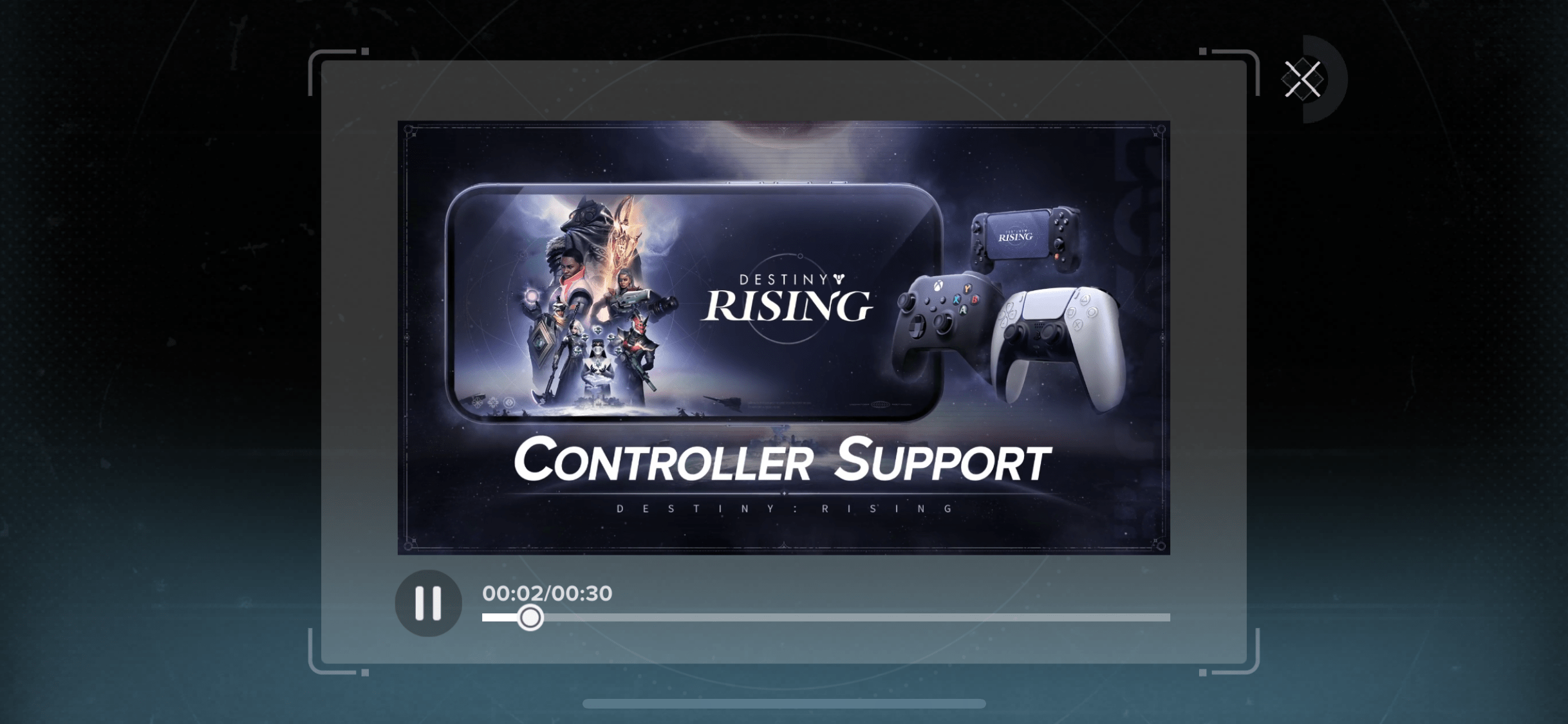
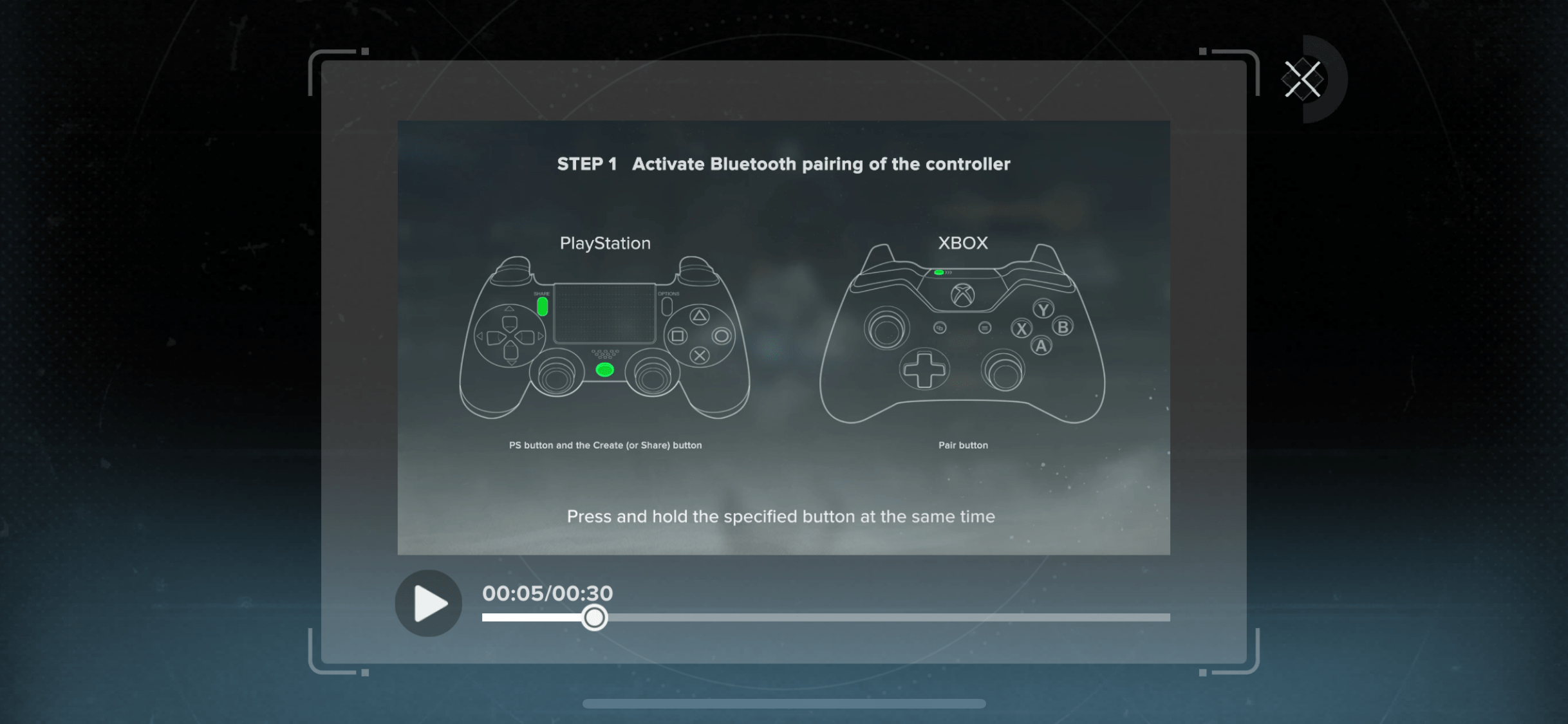
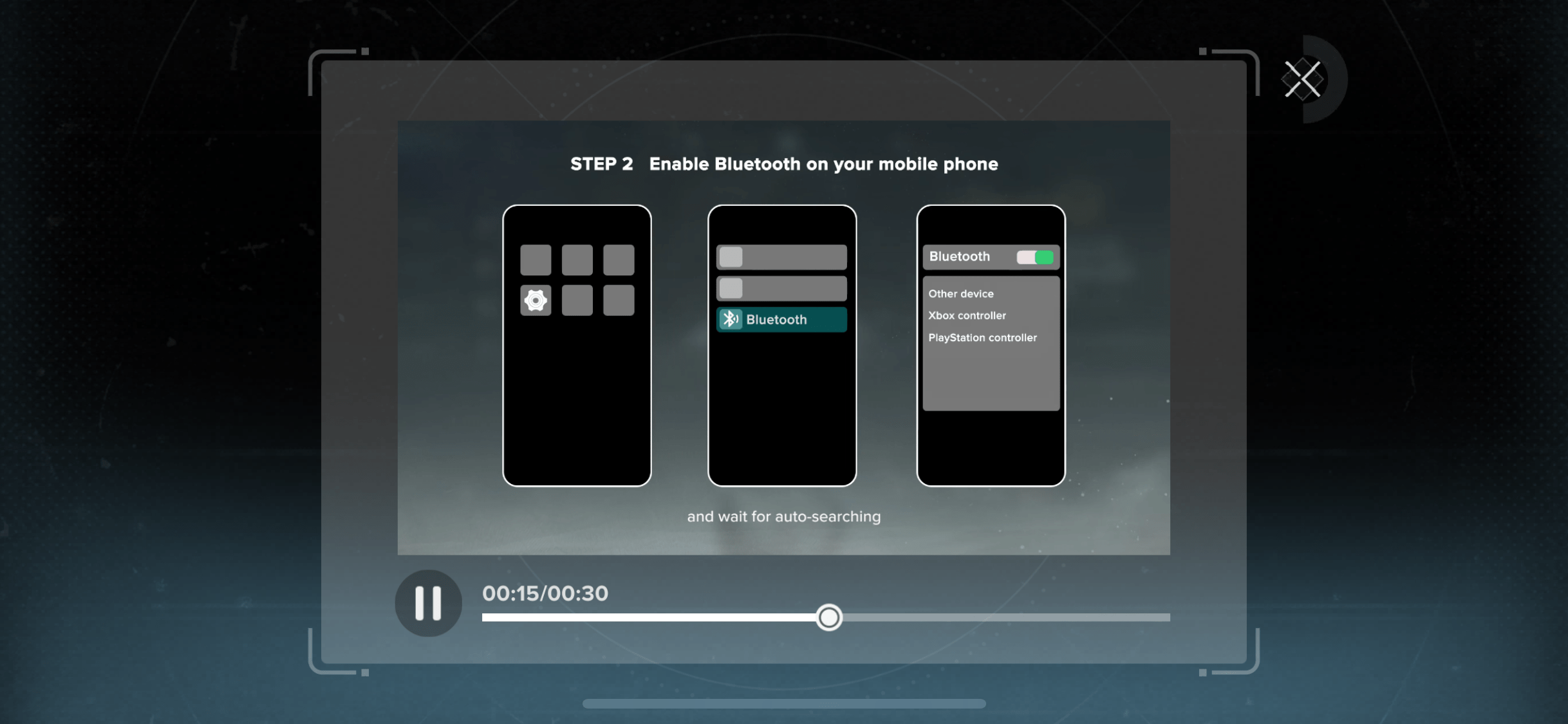
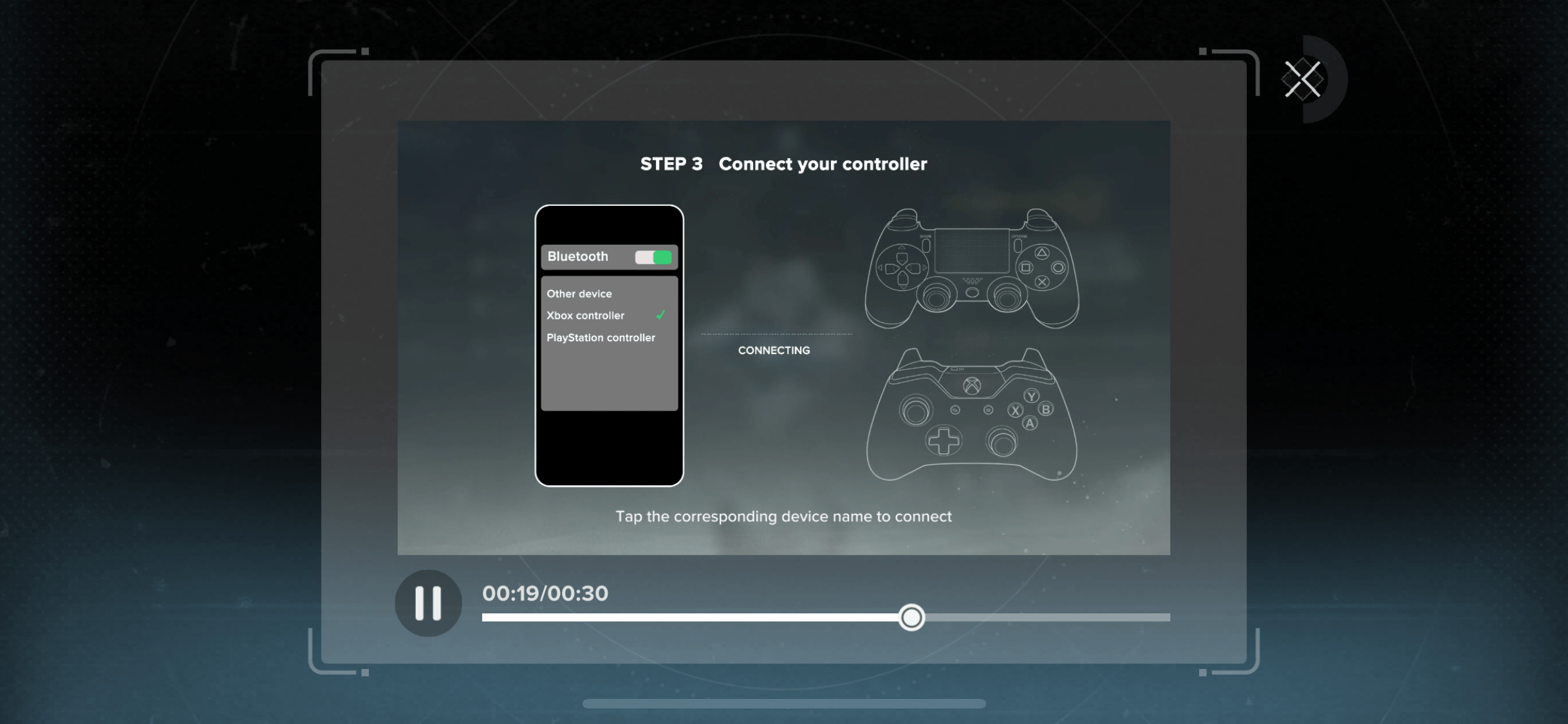
Destiny Rising works with controllers on both iOS and Android. Supported devices include DualShock 4, DualSense, Xbox One, Xbox Series X|S, and mobile game controllers like Backbone. Simply connect via Bluetooth or USB, and the game will automatically adjust the controls.
When playing with a controller, you can fine-tune:
- Stick sensitivity;
- Axis inversion;
- Vibration feedback;
- ADS toggle behavior (per weapon type).
All of these options are available in the in-game menu.
How to Play Destiny Rising on PC
Want to play on a bigger screen with a mouse and keyboard? You can run Destiny Rising on PC using Android emulators:
- BlueStacks: popular and stable, with macro scripts, multi-instance support, and advanced key mapping;
- MuMuPlayer: lightweight and efficient, optimized for higher FPS and suitable for low-spec PCs.
What you can customize in emulators while playing Destiny Rising:
- Keybindings for mouse and keyboard;
- Controller support (PlayStation/Xbox via Bluetooth or USB);
- High FPS settings, Vulkan rendering, full screen, and screen scaling.
With emulators, the experience feels almost like playing on a console.
Destiny Rising Characters

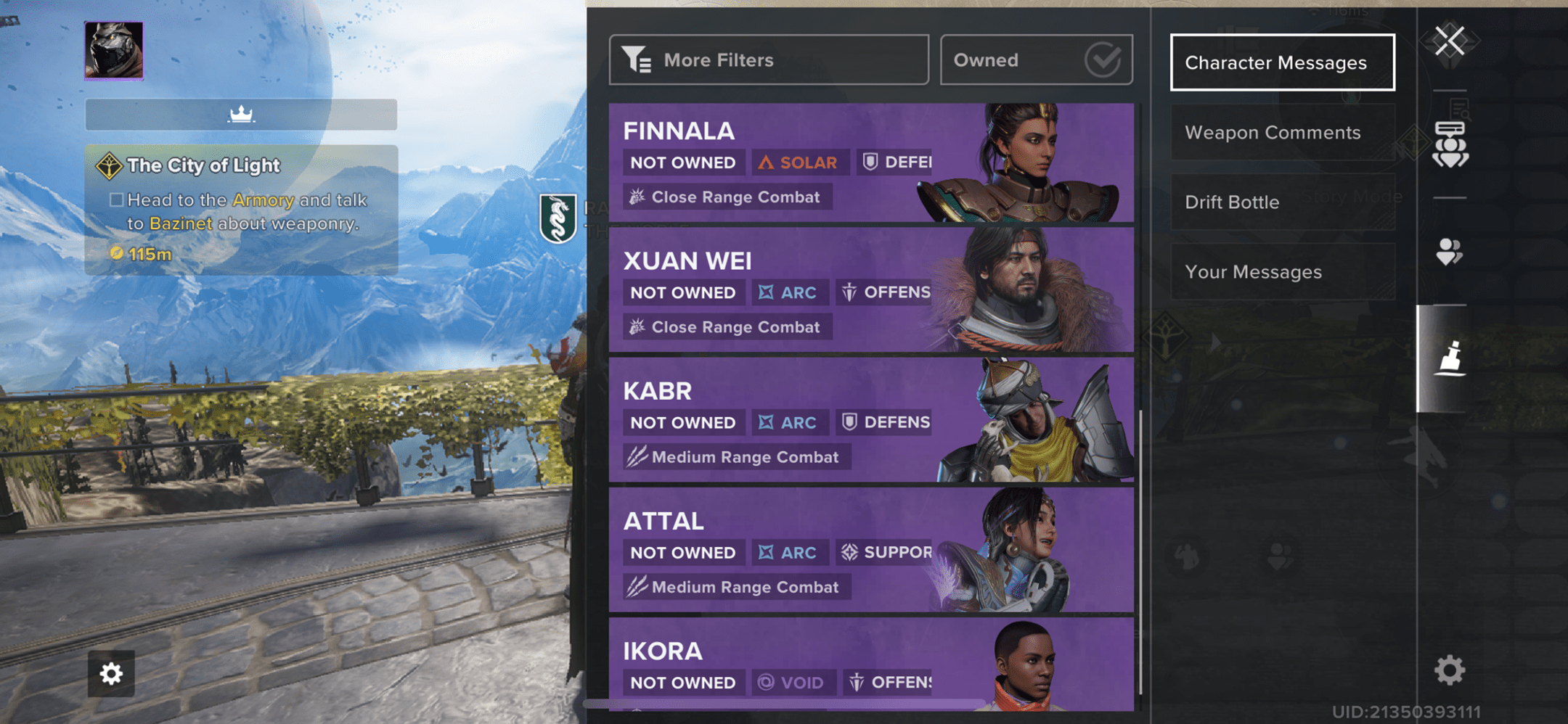
In Destiny Rising, you can unlock unique heroes called Lightbearers, each with their own combat style, elemental affinity, and role. At launch, there are 10 characters available: Attal, Kabr, Wolf, Gwynn, Jolder, Maru, Ning Fei, Tan-2, Finnala, Ikora. These are a mix of familiar faces from the Destiny universe and brand-new heroes created just for this game.
📌 Keep in mind that thanks to the Team Level you don’t have to level up each character separately, your progress will be shared among them all.
| Character | Role | Playstyle |
|---|---|---|
| Attal | Healing support with ranged healing birds | Team support, sustain |
| Kabr | Tank with lightning and shield abilities | Frontline defense, crowd control |
| Wolf | Fire‑based AoE damage, debuffs | Fast clears, sustained DPS |
| Gwynn | Electric burst with shielding | Mid‑range combat, sustained encounters |
| Jolder | Aggressive melee/tank hybrid | Survivability + offense |
| Maru | Balanced offense/defense with fields | Endgame DPS, shielded offense |
| Ning Fei | Mobility, clone summons, AoE | Speed runs, multi-target disruption |
| Tan-2 | Team buff/deep single-target DPS | Boss fights, team damage boost |
| Finnala | Pulls enemies in, area whirlwind | Crowd control, AoE zones |
| Ikora | Area spells, team buffs | Strategic plays, team-oriented fights |
Destiny Rising Classes
In Destiny Rising, there are no traditional classes, but heroes are still divided into three key aspects: Element, Role, and Combat Style. These categories help you understand what each character can do in battle and which ones best fit your personal playstyle.
If you are not sure that you are proficient enough in your character, but you don’t want to miss the progress in various activities, we can assist you. Our team will take care of Gauntlet Blitz for you, earning valuable materials and currency.
Destiny Rising Elements

Elements in Destiny Rising define a hero’s damage type and overall skill flavor:
| Element | What It Does | Heroes |
|---|---|---|
| Arc | Electricity and speed; stuns enemies and buffs allies. | Ning Fei, Xuan Wei, Kabr, Attal |
| Solar | AoE damage and aggressive play; great for fast farming. | Tan-2, Wolf, Finnala |
| Void | Battlefield control, debuffs, and team protection. | Jolder, Gwynn, Ikora |
Destiny Rising Roles

Roles in Destiny Rising explain what purpose a hero serves. There are three basic roles:
| Role | Purpose | Heroes |
|---|---|---|
| Offense | Main source of damage for the team. | Ning Fei, Gwynn, Wolf, Xuan Wei, Ikora |
| Support | Heals, shields, and buffs allies. | Tan-2, Attal |
| Defense | Soaks damage, holds aggro, and controls crowds. | Jolder, Finnala, Kabr |
Destiny Rising Combat Styles

Combat Styles describe how each hero fights on the battlefield in Destiny Rising:
| Combat Style | Description | Example Heroes |
|---|---|---|
| Close Range Combat | Close-range fighters with high survivability and pressure. | Ning Fei, Jolder, Gwynn, Finnala, Xuan Wei |
| Medium Combat | Mix of melee and ranged for flexible play. | Wolf, Kabr, Attal |
| Long Range Combat | Consistent damage from distance with guns or spells. | Tan-2, Ikora |
Destiny Rising Weapons

In Destiny Rising, weapons are divided by Element (Kinetic, Solar, Arc, Void), Combat Style (Rapid-Fire, Spread, Piercing, Impact), and Quality (Exotic, Mythic, Legendary, Rare). There are a total of 96 weapons in the game: around 16 Rare, 31 Legendary, 30 Mythic, and 19 Exotic.
Rare weapons are useful only at the start, while Legendary, Mythic, and Exotic are essential for endgame builds. The only restriction is that you can equip only one Exotic weapon, but Mythic weapons have no limit — they are the backbone of top-tier setups. All weapons can be split into two weapon types in Destiny Rising: Primary and Power weapons.
Primary Weapons — have infinite ammo, making them reliable for regular fights and precision shooting.
- Auto Rifle;
- Pulse Rifle;
- Scout Rifle;
- Hand Cannon;
- Submachine Gun;
- Sidearm.
Power Weapons — deal heavy damage but have limited ammo, making them perfect for boss encounters and shielded enemies.
- Sword;
- Shotgun;
- Sniper Rifle;
- Grenade Launcher;
- Rocket Launcher;
- Machine Gun;
- Light Grenade Launcher;
- Linear Fusion Rifle;
- Auto Crossbow.
Destiny Rising Weapon Tips
If you are a beginner in Destiny Rising and you don’t know which weapon to choose, follow our list of useful tips:
- At the start of the game, it’s best to stick with Primary Weapons like auto rifles or pulse rifles. They have infinite ammo and work well for any mission.
- As soon as you can, make sure to include at least one Power Weapon — a shotgun or rocket launcher. These are perfect for quickly taking down elite enemies and bosses.
- Don’t waste resources upgrading Rare weapons. Focus on Legendary and higher — they’ll stay useful much longer.
- If you get an Exotic, make it the centerpiece of your build and adjust the rest of your loadout around it.
Destiny Rising Campaign

Once you launch the game, you’ll play as Wolf, a base character, who’ll be your first to test and to make you acquainted with the in-game mechanics. Also, you’ll complete some introductory activities that will allow you to unlock all essentials: new abilities, weapon upgrades, daily quests, main story activities, and more.
The campaign is split into several parts and broken down into missions, where you gradually uncover the story, meet allies, and face bosses. It’s also a great way to level up your characters, earn currency, and learn the basics of the combat system.
All Destiny Rising Campaign Parts:
- Part 1: Intro and Meeting Radegast;
- Part 2: Haven;
- Part 3: Sword of Light;
- Part 4: City in the Snowstorm;
- Part 5: Gathering a Fireteam;
- Part 6: Beneath the Ice;
- Part 7: Kevarrh’s Loyalty;
- Part 8: Hero’s Trial;
- Part 9: Surge of Memories;
- Part 10: Path to the Light;
- Part 11: Operation Avenging Arrow.
In addition to the campaign, the game features separate Destiny Rising extra activities:
- Strike: Fulminator;
- Strike: The Pit;
- Patrol: Jiangshi Metro;
- Activity: Singularity (Order);
- Activity: Gauntlet Blitz;
- Activity: Gauntlet Onslaught.
Destiny Rising Quests
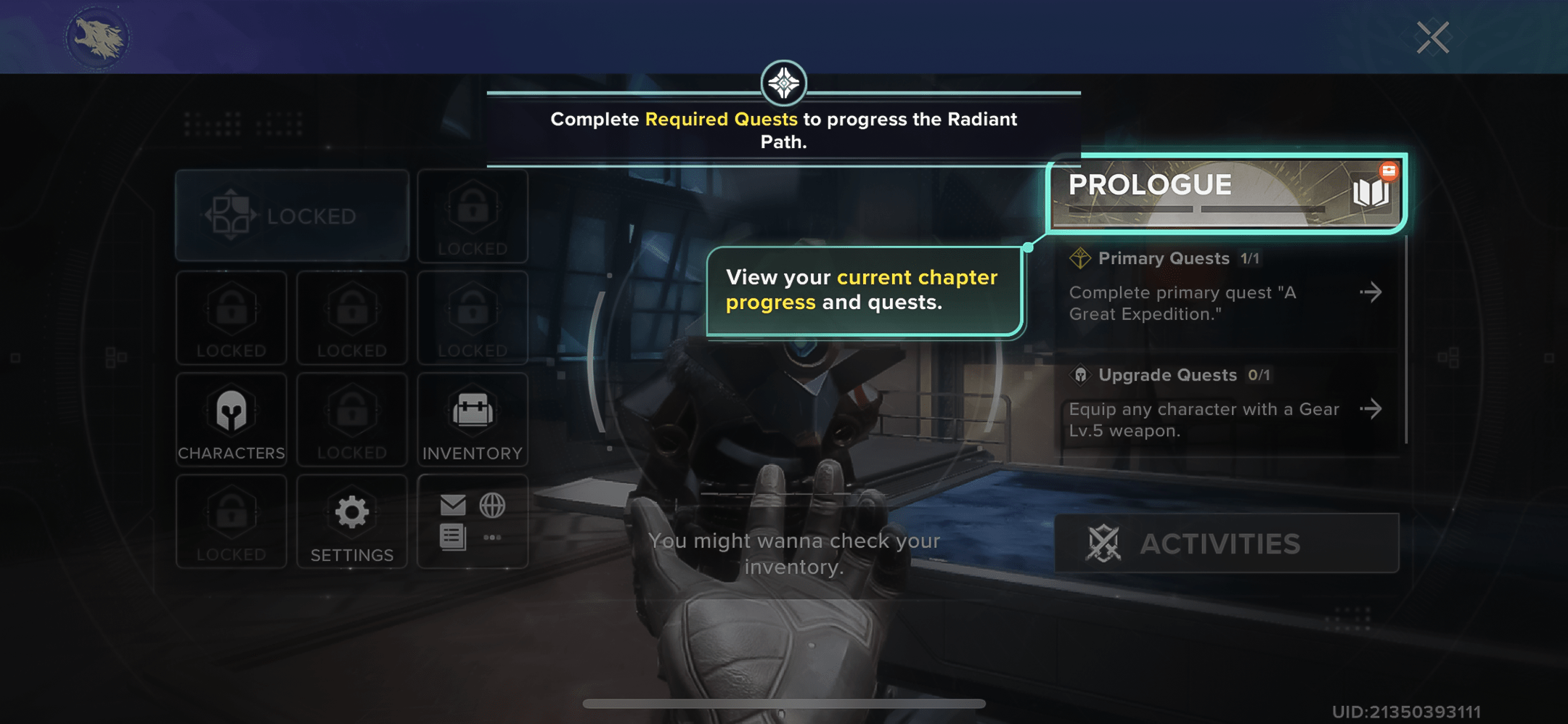
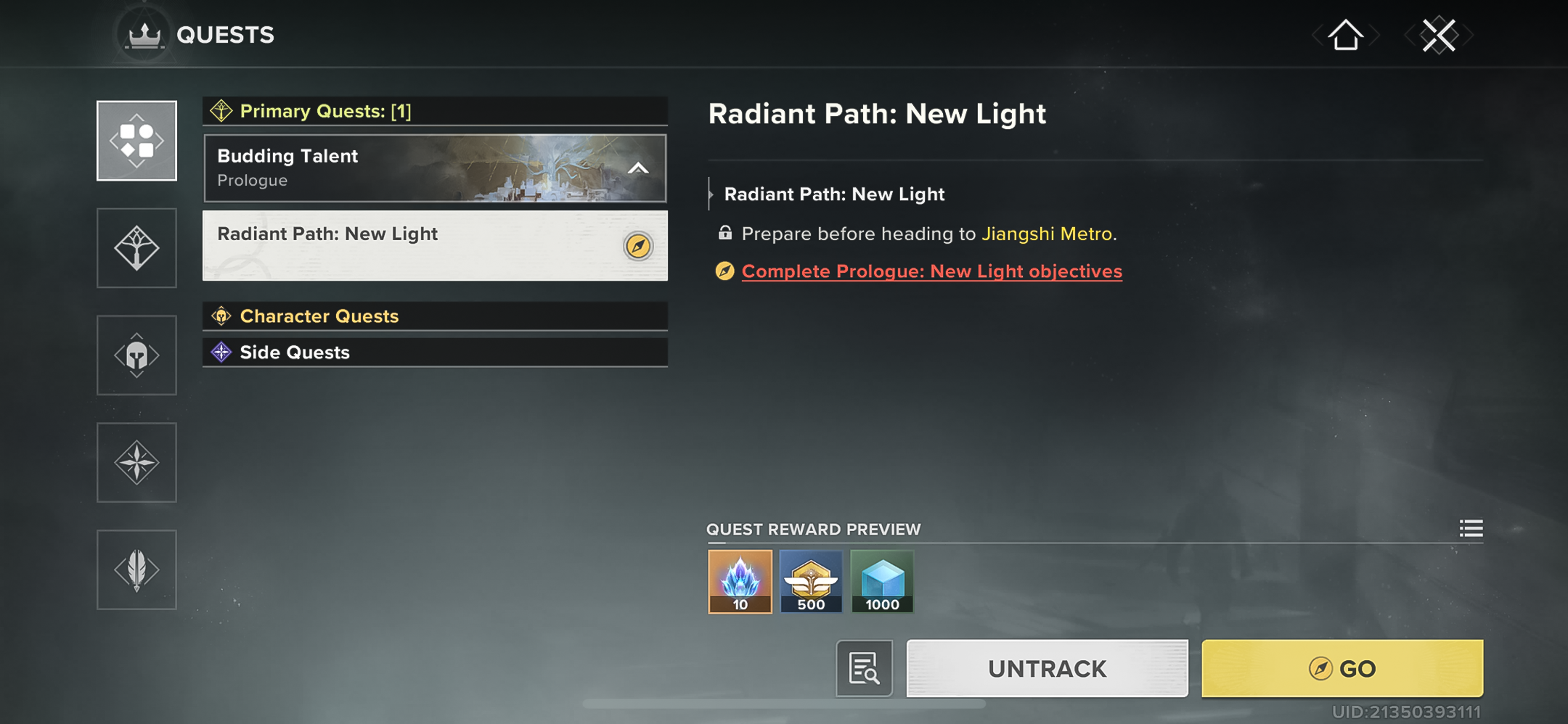
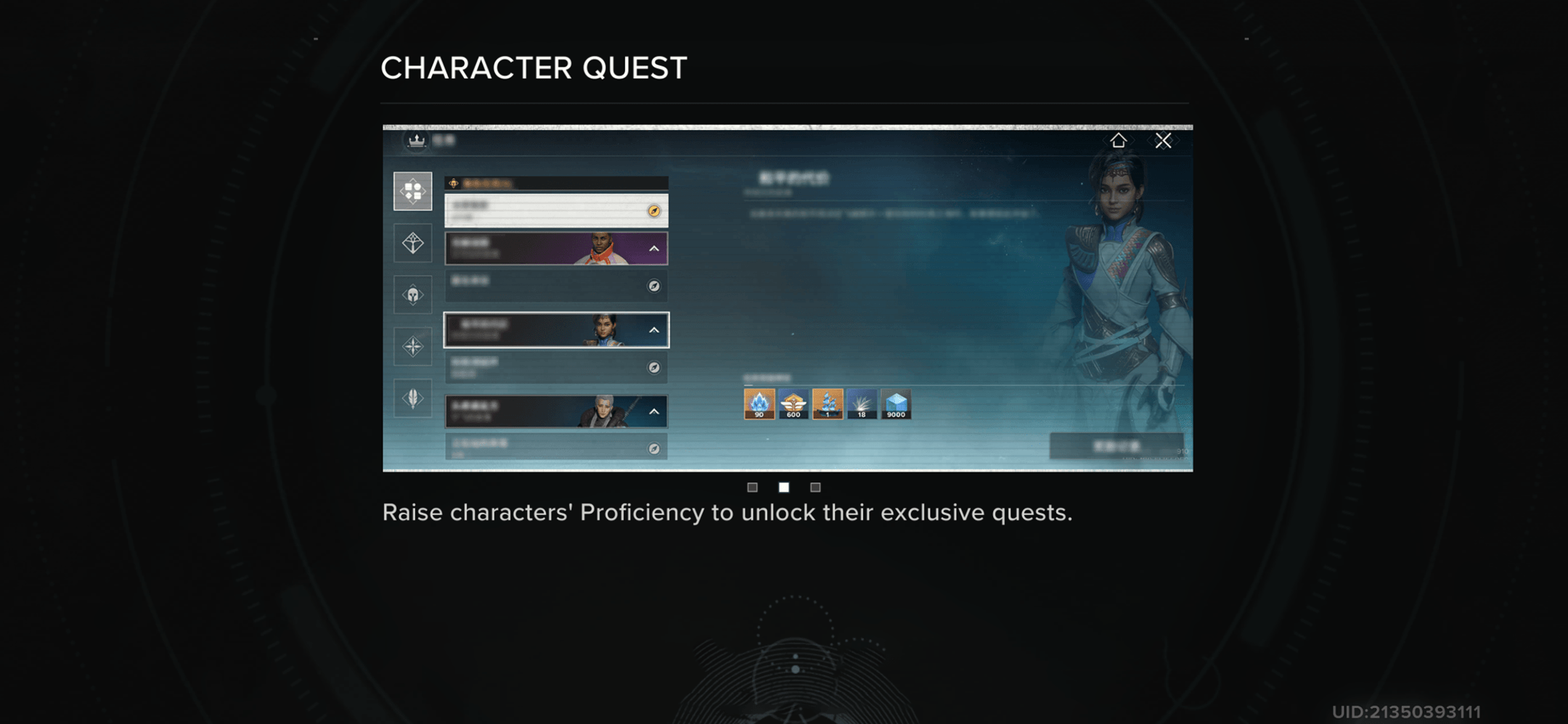
Quests in Destiny Rising are the backbone of progression and the main way the game leads you through its world. Primary Quests (they are often marked as Required Quests) push the story forward and unlock new zones, Character Quests explore the personal stories of Lightbearers, Side Quests add extra activities and rewards, and Daily Quests provide a steady flow of Glimmer and materials. This structure makes the game easy to follow — you always know where to continue the story, where to farm resources, and how to keep moving forward.
| Quest Type | Description | Why It Matters |
|---|---|---|
| Primary Quests | Main story missions shaping the campaign | Unlock story, zones, major gear |
| Character Quests | Hero-specific missions tied to individual Lightbearers | Deepen lore, earn bonus items |
| Side Quests | Optional tasks from NPCs around hubs | Bonus rewards and content variety |
| Daily Quests | Short, repeating tasks for consistent rewards | Steady Glimmer, materials, daily growth |
Destiny Rising Tips for Beginners
If you’re just starting out in Destiny Rising, these tips will help you settle in quickly and make your progress more efficient. From AFK farming to daily routines, here’s what every beginner should know. Here we have gathered some of the most helpful beginner tips for Destiny Rising:
| Tip | Description |
|---|---|
| AFK Farming with Iron Commander | Once you finish the campaign, the Iron Commander feature unlocks. You can send up to three fireteams on 24-hour auto-runs. They return with currency, materials, and XP even while you’re offline — a great way to progress without constant play. |
| Don’t Skip Daily Quests | Daily quests provide Glimmer, materials, and XP. Even if you don’t have much time, clear them in 10–15 minutes to keep up with rewards. |
| Play on PC or With a Controller | Though Destiny Rising is a mobile game, it’s often more comfortable on PC via emulators (like BlueStacks or MuMu) or with a controller. Better controls make farming smoother and gameplay easier to handle. |
| Plan Your Team Level Progress | Focus on campaign missions, public events, and dailies — these drive Team Level growth. Any new hero you unlock will instantly scale to your current level. |
| Use Auto-Fire | Enable Auto-Fire in the controls menu to automatically shoot when aiming at enemies. It makes battles easier and reduces finger strain in long sessions. |
| Save Your Lumia Leaves | Don’t spend them on the first banner you see. Collect and use them wisely — they’re one of the most valuable currencies for unlocking Mythic heroes. |
4.9That wraps up our Destiny Rising overview, where we covered all the key gameplay features. Good luck as you dive into the campaign, master every weapon type, and complete all the quests. And don’t forget to check in daily for ways to earn currency so you don’t miss out on precious Silver and other rewards.
